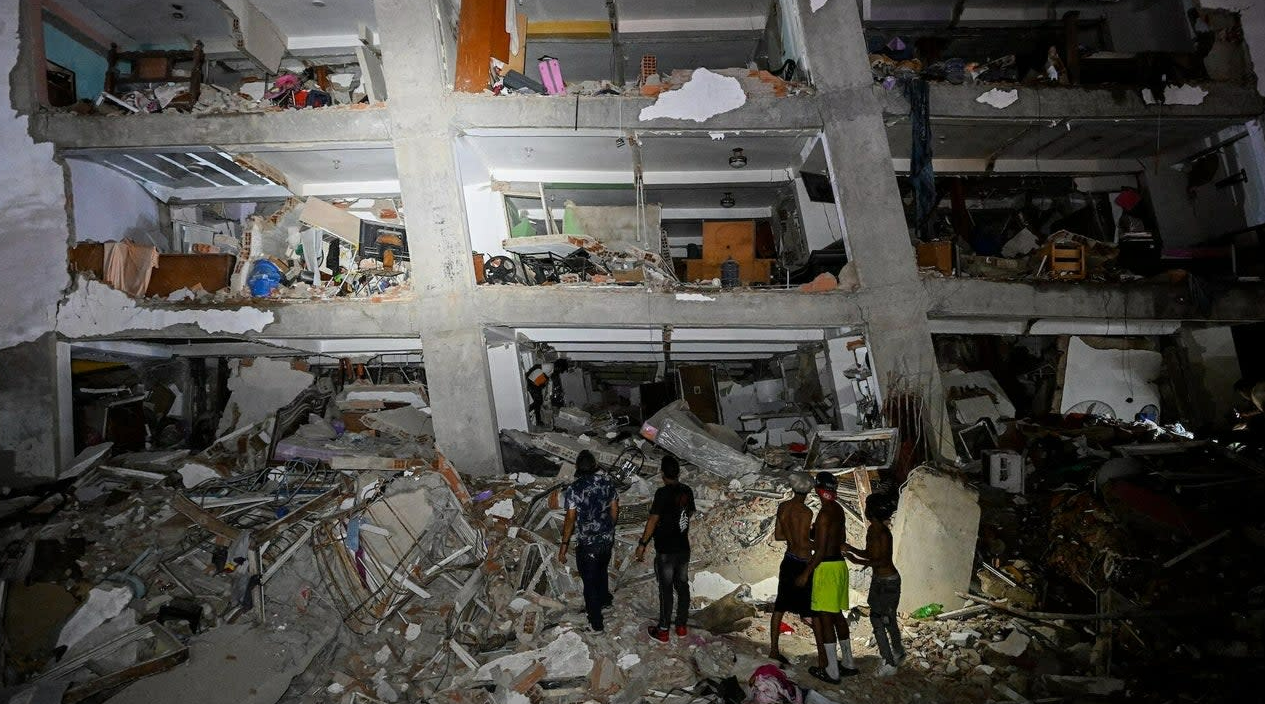
LA GUAIRA, Venezuela — Rescue teams worked tirelessly across northern Venezuela on Thursday as desperate families searched through collapsed buildings following two powerful earthquakes that left at least 235 people dead, more than 4,300 injured, and thousands still missing.
Authorities warned the death toll is expected to climb significantly as emergency crews continue searching for survivors trapped beneath mountains of concrete and twisted steel.
Health Minister Carlos Alvarado confirmed that many victims arrived at hospitals without signs of life.
“Unfortunately, around 235 people were brought to our medical facilities without vital signs or died shortly after arrival,” Alvarado said in remarks to state media.
The twin earthquakes, measuring 7.2 and 7.5 in magnitude, struck just one minute apart on Wednesday evening, making them among the most powerful seismic events to hit Venezuela in more than a century. Tremors were felt across much of northern South America, prompting evacuations as far away as Brazil’s Amazon region.
Residents Dig Through Rubble With Bare Hands
Across northern Venezuela, scenes of devastation unfolded as frightened residents poured into the streets, searching desperately for missing relatives.
Rescuers pulled injured survivors—many covered in blood and dust—from collapsed buildings. Children and pets were among those rescued.
State television broadcast dramatic footage showing emergency crews freeing a woman trapped beneath a massive concrete slab. Initially, only one of her bare feet was visible before rescuers successfully pulled her out alive.
Outside Caracas, however, many residents said professional rescue teams were nowhere to be seen.
In the capital, Dayana Delgado, the mother of three children, questioned why heavy rescue equipment promised by authorities had not arrived, forcing neighbors to dig through the debris themselves.
“I just want to know where my son is,” she said, referring to her missing eight-year-old child. “Is he trapped under the rubble or has he been taken to a shelter?”
Nearby, another mother collapsed in grief as the bodies of her three- and ten-year-old children were wrapped in blankets and carried away.
Throughout devastated neighborhoods, families shouted the names of missing loved ones while others stood frozen in disbelief.
La Guaira Bears the Brunt of the Disaster
The coastal state of La Guaira, just north of Caracas, suffered some of the worst destruction.
Home to Venezuela’s main international airport, the region now faces additional challenges after the airport was forced to close because of structural damage, complicating the arrival of international aid.
Retired schoolteacher Juan Alberto Mendaño described walking through shattered streets littered with debris and bodies before spotting a woman trapped beneath a collapsed building, desperately waving her hand for help.
“May God rescue her as quickly as possible,” he said. “We heard her cries, but there was nothing we could do.”
Government Declares State of Emergency
Acting President Delcy Rodríguez declared a nationwide state of emergency late Wednesday and announced the creation of a $200 million reconstruction fund to rebuild hospitals, homes, and damaged infrastructure.
She also appealed to construction companies to provide heavy machinery for rescue operations.
“Our priority is to rescue as many people alive as possible,” Rodríguez said, describing La Guaira as a “disaster zone.”
The first international rescue teams from the Dominican Republic were expected to arrive shortly, with additional teams from several countries scheduled to follow.
International Aid Mobilizes
Governments around the world, including the United States, Brazil, Mexico, Canada, Spain, Portugal, and Qatar, pledged emergency assistance.
Relief efforts include:
- Urban search-and-rescue teams
- Medical personnel
- Search dogs
- Emergency medical supplies
- Water purification systems
- Aircraft and drones
U.S. Secretary of State Marco Rubio said Washington was immediately deploying rescue personnel and humanitarian resources, although damage to Venezuela’s main airport posed logistical challenges.
Meanwhile, the U.S. Treasury temporarily eased certain sanctions until October 23, allowing financial transactions related to earthquake relief that would otherwise have been prohibited.
Why Was the Earthquake So Destructive?
According to the U.S. Geological Survey (USGS), the first earthquake struck off Venezuela’s Caribbean coast near Morón at a depth of approximately 22 kilometers (14 miles).
Just one minute later, a second, stronger 7.5-magnitude earthquake struck at a much shallower depth of 10 kilometers (6 miles).
Geophysicist Marcos Ferreira of the Geological Survey of Brazil said the unusual sequence of two powerful, shallow earthquakes dramatically amplified the destruction.
“It’s like one person screaming and another immediately joining in. The vibrations reinforce one another, greatly increasing the destructive potential.”
A Nation in Shock
As powerful aftershocks continued, thousands of residents spent the night sleeping in parks, parking lots, and open spaces, fearing additional building collapses.
“We were terrified the buildings would fall on us,” said María Cristina Díaz, a 41-year-old janitor.
“My mother, my daughter, and I spent the entire night outside. None of us slept.”
Power outages and mobile phone disruptions affected large parts of Caracas. Metro services were suspended, natural gas supplies were shut off, and schools were closed for several days, with many campuses converted into emergency shelters and donation centers.
Families posted photographs of missing relatives on walls, social media, and makeshift bulletin boards while Venezuelans living abroad struggled to contact loved ones.
Search for Survivors Continues
As rescue workers continue digging through collapsed buildings, hope remains that more survivors can still be found.
However, with thousands of people still unaccounted for and many devastated communities yet to be fully reached, officials warn that the number of casualties is likely to increase in the coming days.
The twin earthquakes have become one of the deadliest natural disasters to strike Venezuela in generations, leaving an entire nation mourning while clinging to hope amid the ruins.