The World Economic Forum (WEF) in Davos, Switzerland—traditionally a sanctuary for global cooperation and polite handshakes—has just been rocked by a political earthquake named Donald Trump. Only 72 hours after taking his second oath of office, Trump delivered a message that could not have been more shocking: threatening allies, demanding to purchase Greenland, and presenting economic figures that left financial experts reeling. This was not just a speech; it was a declaration of war against the old world order, right in the “den” of the global elite.
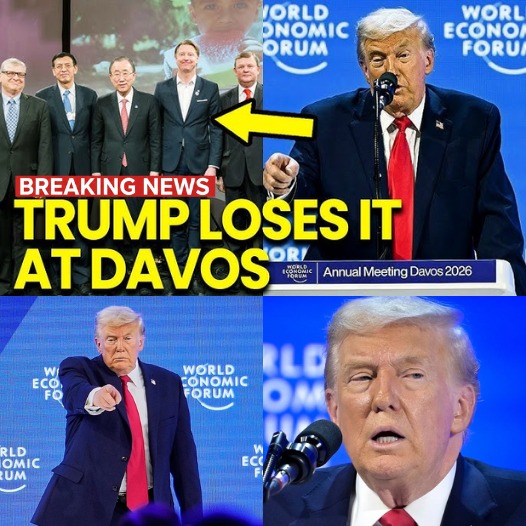
On January 21, 2026, the world held its breath for Trump’s first major international address of his new term. Instead of a discourse on peace and investment, Trump transformed Davos into a battleground. European leaders were described as “cringing” at his harsh rhetoric, while major banks issued warnings of a looming economic catastrophe.
Trump began by proclaiming a “Golden Age of America” following a landslide victory across all seven swing states. He called it a “revolution of common sense”. However, what followed was what diplomats are calling a “true diplomatic disaster”.
The most bizarre and controversial point of the speech was Trump’s obsession with Greenland. He called the island a “big beautiful piece of ice” and insisted that the United States needs “right, title, and ownership” of it.
Linguistic Contradiction: Trump stated he would not use force to take Greenland, but immediately followed by emphasizing that the U.S. would be “unstoppable in any armed conflict”.The Veiled Threat: He sent a message to Europe that they should “move out of the way” or “remember their choice”.
For Denmark and NATO allies, this is no longer a joke. The prospect of one NATO member threatening the sovereignty of another could lead to the collapse of Article 5 and the entire Western alliance.
Trump spent a significant amount of time insulting European nations on their own soil. He called those investing in green energy “stupid people” and mocked that if not for American intervention in WWII, all Europeans would currently be speaking German.
Notably, he made these remarks in the German-speaking region of Switzerland, leaving the audience stunned. Rather than building relationships, Trump seemed to be intentionally provoking resentment to demonstrate the power of his “America First” policy.
Economically, Trump made claims that fact-checkers struggled to keep up with:
Trade Statistics: He claimed tariffs helped slash the U.S. trade deficit by 77% in one year without causing inflation. Economists pointed out these numbers have absolutely no basis in reality.Credit Card Interest Rate Cap: Trump proposed a 10% interest rate cap to help consumers. However, Jamie Dimon—CEO of JPMorgan Chase—immediately warned that this would be a “disaster,” making credit entirely inaccessible for the poor.Venezuela Oil Scenario: He claimed Venezuela would earn more in the next 6 months than in the last 20 years due to his energy strategy. Again, experts called this “pure fantasy”.
The Davos speech was not just empty talk; it carries real-world consequences:
Loss of Ally Trust: European nations are beginning to plan their own defense and trade cooperation without U.S. involvement, fearing that Washington is no longer a reliable partner.Market Instability: The uncertainty from these policy proposals and “imaginary” data is worrying investors, potentially leading to higher interest rates and slower economic growth.Opportunity for Rivals: A divided West is the best possible news for Russia and China, as they see their main adversary creating internal chaos.
For supporters, this is evidence of Trump’s courage in speaking the truth and protecting American interests. For critics, it marks the beginning of a dangerous term where economic and diplomatic ignorance will erode the United States’ standing.
Whichever way you view it, the Davos speech has set a new tone for the next four years: Unceasing Chaos. The world must now face the reality that while the President’s words may not be based on data, they have the power to swing markets and shatter the longest-standing alliances in history.