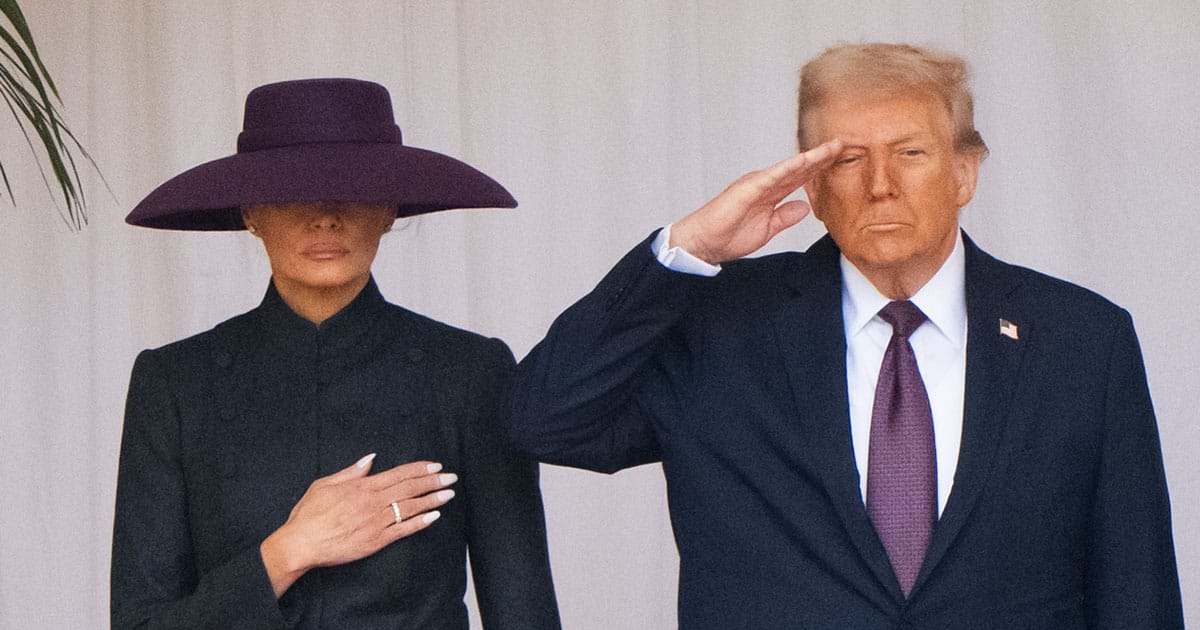
When Donald Trump and his wife, Melania, touched down in Windsor for their state visit, the choreography was familiar—rotors thudding, a sweep of motorcade, the poised arrival line of senior royals. Yet even before the handshakes finished, the First Lady’s hat had become the talking point. It wasn’t just eye-catching; it felt intentional, the sort of fashion choice that seems to speak even when its wearer doesn’t.
This second full state visit broke with recent precedent and stirred its own debate about timing and tradition. Usually, a returning U.S. president might be hosted for tea or a luncheon rather than another formal state call. Whether the gap between presidential terms, the accession of a new monarch, or broader diplomatic calculations shaped the invitation, the stage was unmistakably set for symbolism. In that theater, clothing is never merely clothing.
Melania arrived in a tailored gray Dior suit—streamlined, almost architectural in its lines. The suit would have been notable on its own, but it served as a calm frame for the dramatic, wide-brimmed hat in deep purple. The brim dipped low enough to hide her eyes in some moments, lending her profile a movie-still quality. For many, it conjured a flashback: the broad-brimmed white hat she wore in Washington in 2018 that sparked a thousand memes when it briefly foiled a greeting kiss. She understands how hats play on camera; Britain, perhaps more than any other place, understands too. Millinery is a language here. Royals and guests use brims and crowns the way orators use cadence.
Color sharpened the message. Purple is historically freighted—royal in Britain, and in the United States a visual blend of red and blue. On a day packed with pageantry, Trump skipped his signature red tie for one in nearly the same purple as Melania’s hat. The coordination read like a quiet duet, tidy and deliberate. For some observers, the shade suggested unity; for others, it simply harmonized two looks across a sea of uniforms and scarlet tunics. Either way, the optics were precise.
The silhouette itself carried subtext. A wide brim that partially obscures the face can deflect attention as much as it attracts it. It creates frames, steals and returns focus, and can feel like a handheld fan transformed into architecture. There’s a strain of etiquette, especially in royal settings, that prizes modesty without disappearing—“seen, but not seen through.” In that sense, the choice echoed a familiar Melania hallmark: polished, composed, and carefully un-readable. Some stylists reading the look argued she was signaling deference to the occasion and leaving center stage to the head of state; others saw a woman asserting presence on her own terms. Both readings can be true at once.
The day’s formalities offered a sweeping canvas for such interpretations. After a welcome at Windsor Castle, the president joined King Charles to review a guard of honor drawn from three storied Household Division regiments—the Grenadier Guards, the Coldstream Guards, and the Scots Guards. The Quadrangle at Windsor is made for ceremony; uniforms flash, boots thunder, bugles carry in the open air. It’s a place where centuries hang in the light and where small gestures—who walks first, who pauses, who turns—are watched closely. Against that tapestry of crimson, bearskins, and brass, the First Lady’s gray-and-purple palette stood out without shouting.
Later, the presidential couple visited sites that underline the historic relationship between Britain and the United States, including a moment of quiet at the ledger stone marking Queen Elizabeth II’s resting place. The image was stark: two Americans in formal dress laying a wreath, a reminder that state visits are equal parts diplomacy and ritual. In the evening, Windsor reset itself yet again, exchanging daylight’s brilliant pageant for the soft gleam of chandeliers. A state banquet is a ballet of seating plans, speeches, and silver. Tails and white tie for the men; floor-length gowns and heirloom jewels for the women of the royal family. Guests, too, lean into formality. The First Lady moved from daywear to eveningwear, trading the architectural daylight suit for a gown suited to the gravity of the room, while the hat—its work done—stayed behind.
Reactions to the hat rippled quickly. British millinery is part craft, part sport; people keep score. The brim width, the slope, the crown height—these details ignite the same energy fashion fans bring to runway shows. Some praised the choice as a confident nod to British tradition, the kind of playful seriousness that a state visit welcomes. Others preferred slimmer brims and more open faces, noting that eye contact is its own kind of diplomacy. Still others latched onto the color story, reading purple as a sleek bridge between partisan signatures across the Atlantic. Whether one buys that symbolism or not, the coordination with the president’s tie was the kind of deliberate echo that stylists rarely leave to chance.
It’s also worth remembering how hats function in British public life. They’re punctuation marks: joyful at weddings, reverent at commemorations, restrained at somber events, exuberant when the nation celebrates. For visiting first ladies, choosing a hat can be a respectful salute to the host country’s sartorial grammar. Diana, Princess of Wales; the late Queen; and now the Princess of Wales have all set a high bar for headwear diplomacy. To step into that conversation is to accept that your hat will be read as a sentence, not just an accessory.
There’s a practical side to the brim, too. Outdoors, a hat creates a little room that cameras can’t easily trespass. It gives the wearer control—who sees what, and when. In a setting where every blink is photographed, a brim can be a shield. It’s possible to be public without feeling exposed.
The day’s other visuals carried their own currents. The inspection of the guard of honor, with its centuries-deep lineage, places a premium on timing and proximity: who gestures, who waits, who follows the line of troops. The afternoon wreath-laying introduced a muted note of reflection. Evening brought the banquet’s choreography—speeches that thread warmth and policy, toasts that strike carefully balanced notes, and seating that tells its own story of alliances and priorities. Within that marathon of imagery, the First Lady’s daytime hat became one frame among many, but a memorable one.
Soft-power dressing is often described as a whisper that carries. The First Lady’s look fit that definition. The Dior suit nodded to European couture without competing with royal finery; the purple tie-and-hat pairing suggested unity; the brim’s theatrics acknowledged the host nation’s love affair with millinery. Nothing in the outfit would be out of place in a black-and-white photo from another era—that’s part of its appeal. It’s classic enough to feel timeless, specific enough to spark conversation.
By the end of the day, the images had already settled into their narratives: the four-person greeting line at Windsor, the marching guards, the contemplative wreath at a beloved monarch’s grave, the procession into a banquet hall glittering with crystal and state china. Somewhere in that collage sits a purple hat that hid a pair of eyes and launched a thousand interpretations.
Maybe that’s the point. In settings like this, clothes carry messages precisely because words are measured. You don’t always say what you’re thinking at a state banquet. You let fabric, color, and silhouette help you speak. Whether you saw deference, coordination, mystery, or simply good design in Melania Trump’s hat, the choice did what the best diplomatic dressing does: it invited you to look closer.
If you watched the arrival and caught yourself pausing on the hat—on the brim that turned light into shadow, on the color that threaded daywear to neckwear—you were part of that conversation. And if you have a take on what it said, you’re not alone. Hats, after all, are meant to be worn—and debated. What did you see in this one?