I heard the scream before I heard my name. It was the kind of sound that empties your lungs first and asks questions later—high, broken, echoing down the hallway until it shook the picture frames on the wall.
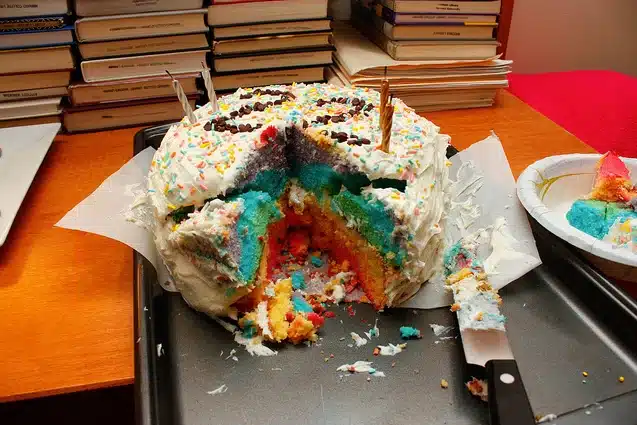
I ran to the kitchen and found Sophie on tiptoe at the counter, hands clamped to her mouth, eyes wide and wet. The bakery box I’d tucked into the refrigerator like a treasure chest sat open, and what should have been a three-layer pink dream looked like it had been dragged across the floor. Frosting smeared in wounded swirls, buttercream flowers crushed into little pastel bruises, and the message—“Happy 9th Birthday, Sophie”—reduced to streaks and crumbs.
“My cake,” she whispered, and then the dam broke. “Mom, who would do this?”
I pulled her close, breathing in bubblegum shampoo and salt tears, while my eyes scanned the doorway, the floor, the room. The party pulsed just beyond the archway—kids laughing, paper crowns crinkling, a dozen little feet squeaking on wood. The adults were gathered in clumps, cups of lemonade in their hands, polite smiles in place. And there, seated apart like a queen without a court, was James’s mother, Helen. Hands folded. Mouth almost, almost smiling.
I didn’t want to believe it. But I knew.
I set Sophie’s head against my shoulder and called out, “Helen, can you come here a moment?”
She rose slowly, the way people do when they’re already certain of their next line. “What is it?”
I stepped aside so she could see. “Did you open the fridge? Did you touch the cake?”
Her gaze slid over the wreckage, cool as glass. “Why would I touch a cake?”
Sophie turned her face, cheeks streaked. “Grandma… why?”
For the smallest fraction of a second, something flickered. Then Helen’s expression settled into something hard. “Because, Sophie, you are not really mine. You’re not even James’s. You’re someone else’s child. And I am tired of pretending.”
I felt it in my chest—a tight, hot coil of anger and disbelief. Sophie flinched like the words were a slap. She pressed herself into me until her little fingers dug crescents into my side.
“What’s going on?” James’s voice came from behind us, and when he saw the cake, saw Sophie’s tears, and then saw his mother, his face changed. The warmth vanished, replaced by something fierce and unfamiliar.
“Helen,” he said, each syllable careful, “what did you say?”
“I told the truth,” she replied. “It’s foolish to pour your love into a child who isn’t yours. One day you’ll wake up and regret all this… pretending.”
There are moments that draw a line straight through a life. James stepped over that line in a single breath.
“Sophie is my daughter,” he said. “She became mine the day I chose her. That was not pretending—that was a promise. If you can’t accept that, then you can’t be here.”
Helen scoffed, but her eyes flickered. “You’re making a mistake.”
“My only mistake,” he said, “was letting you near her long enough to hurt her.”
Silence pressed in from every corner. Then Helen lifted her chin, grabbed her purse, and swept out, the front door rattling the windows as it slammed. The party sounds on the other side of the archway fell into an awkward hush. James exhaled, ragged and slow, and then dropped to one knee in front of Sophie.
“Look at me, Princess,” he said gently, taking her hands. “You are mine. Always. I love you. That’s not a sentiment—it’s a fact. Nothing she says can change it.”
Her face crumpled again, but the cry that came was smaller, softer, like a storm moving offshore. She leaned forward and folded herself into his arms. I bent and wrapped them both, and for a long moment we just breathed in a knot on the kitchen floor, frosting cooling on our wrists, balloons shivering in the doorway.
“Stay with Mommy,” James said at last, brushing a curl from Sophie’s forehead. He stood, grabbed his keys, and kissed the top of her head. “I’ll be back soon.”
I didn’t ask where he was going. I guided Sophie to the couch, tucked a blanket around her legs, and put on the fairy lights we’d strung that morning. The house glowed soft and pink, riddled with glitter and paper streamers, the evidence of joy scattered everywhere. It made the ruined cake feel like a cruel joke. I stroked her hair and said the words I needed to hear myself: “You are safe. You are loved. This is your home.”
Half an hour later, the door opened. James stepped inside carrying a white box tied with a ribbon and a bundle of pink balloons bobbing like captured clouds. He set the box on the table and looked at Sophie with a smile that was still a little broken around the edges.
“No one ruins your birthday,” he said. “Not on my watch.”
We lifted the lid together. Inside was a cake that looked like a storybook—three tiers, pastel frosting, a dusting of edible sparkle, and a tiny unicorn standing tall on top. It wasn’t the cake I’d made with my aching arms and careful hands, but the way Sophie gasped made it perfect enough.
We turned down the lights. James lit nine candles, each one a tiny sun. We sang softly, James off-key, me trying not to cry, Sophie’s voice small and brave. She squeezed her eyes shut, made a wish I didn’t ask about, and blew. The candles went out in one breath, smoke curling up like a blessing.
Later, when the last piece disappeared and the kids were picked up, when the house sighed back into itself and Sophie fell asleep clutching a new stuffed unicorn, James and I sat in the living room. The air smelled like sugar and latex and the kind of exhaustion that’s mostly relief.
“She’s ours,” he said, voice low but unshakable.
“I know,” I said, and I meant it in a way I hadn’t had to define before. Ours wasn’t a checkbox on a form. It was a thousand ordinary choices stacked on top of each other until they became a life: a first bike ride, a math worksheet at the kitchen table, a tear wiped away in a grocery aisle, a cake replaced after a cruelty.
I thought back to the day Sophie called him “Dad” in the cereal aisle, to the quick look they shared like they’d both discovered a secret. Family had felt simple then. Today it felt earned.
We cleaned the kitchen together, washing frosting off the counter in pink swirls that faded to white. James paused with a dish towel in his hand. “I’m sorry,” he said. “For not seeing sooner how she made you both feel.”
“You saw it when it mattered,” I said. “That’s what counts.”
He nodded, eyes soft. “She won’t be back.”
“No,” I agreed. “Not if it costs Sophie even one more tear.”
In the quiet that followed, I walked to Sophie’s room and stood in the doorway, watching her sleep. Her lashes fluttered; a tiny smear of frosting still painted the corner of her mouth. The unicorn was tucked under her arm, its glitter horn catching the hallway light. I kissed her forehead and whispered, “Happy birthday, my love. You are ours. You are enough.”
There will be explanations later, conversations about boundaries and love and what “real” means. There will be times she remembers the ruined cake and the words that hurt, and we will meet those memories with truth. Real is not biology alone. Real is who shows up. Real is who runs beside you holding the seat until you find your balance. Real is who replaces the cake, lights the candles, and keeps singing even when their voice shakes.
By morning, the balloons will have lost a little lift, the frosting crumbs will be gone, and the house will smell like coffee again. But something new will be settled in us, too—the certainty that the three of us belong to each other. Not by default. By choice.
And if the day taught us anything, it’s this: families aren’t defined by who shares your blood. They’re made by the people who share your heart—and protect it fiercely when someone tries to break it.