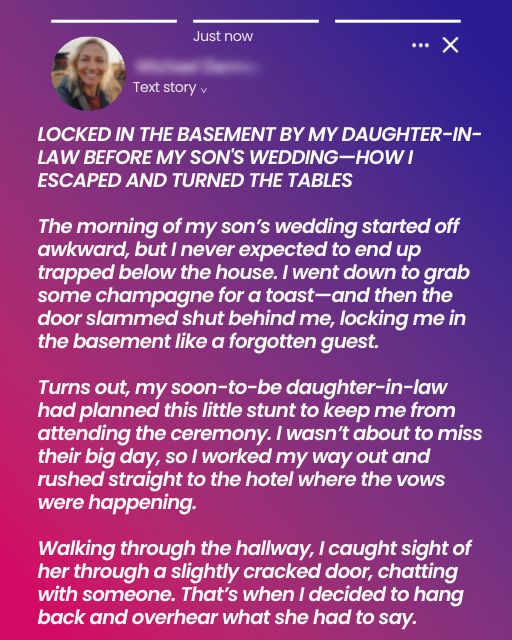
The morning of my son’s wedding began with the kind of politeness that feels like a shirt one size too small—tight in the shoulders, hard to breathe in. We were all playing our parts. I’d arrived early at the house to help with last-minute errands, to stay out of the way, to smile when smiled at. The house was staged like a magazine: white hydrangeas in glass vases, champagne sweating in buckets, bows tied around doorknobs. It smelled faintly of eucalyptus and hairspray.
“Could you grab a few more bottles from the basement?” she asked me, all teeth and courtesy. “For the toast at the hotel.”
“Of course,” I said. I wanted the day to be easy. For my son, I would’ve fetched the moon if someone had put it on a lower shelf.
I flicked on the basement light and descended into cool air and quiet. The latch on the top step made its usual metal-on-wood click. The champagne sat in a crate near the extra refrigerator, labels pearled with condensation. I was halfway back up when the door swung inward and—soft, quick—shut.
Then the deadbolt slid.
At first I thought I’d imagined the sound. I jiggled the handle. Nothing. I set the bottles down. Knocked. The kind of knock that’s a question.
“Hello?” I called, keeping my voice steady. “Hello?”
Upstairs, the house exhaled a floorboard creak, a something being dragged, then silence so complete I heard the compressor of the basement fridge turning over.
I knocked again, louder this time. “Anyone?”
Footsteps passed overhead—brisk, practiced. I pressed my ear to the wood and caught it: the faintest breath of a laugh. Her laugh. Light, bright, rehearsed a thousand times for a thousand rooms.
My mouth went dry. I didn’t shout. I didn’t want to give her the satisfaction of panic. I took stock. The window wells were those small, stubborn kind that tilt inward only three inches. The tools were neatly hung on the pegboard, nothing with a long enough bite to pry at the hinges. My phone was charging upstairs, because this was a wedding day, because we were all trying to be present.
“Okay,” I told the quiet. “Fine.”
I tried the door again for good measure. The bolt held, indifferent.
I don’t know how long I stood there listening to the refrigerator hum and my own pulse in my ears. Time turns syrupy when you’ve been put in a box. I checked the shelves for anything I could use. There was a paint scraper. Rope. A folding step-stool. Somewhere in my mind—an old football coach yelling through a whistle: don’t fight the wrong battle. Keep your head. Find the exit.
The basement had a service hatch for moving furniture—one of those heavy wooden doors that lifts upward on a rusted hinge to the side yard. It was nailed shut from inside, three thick nails long enough to make a carpenter proud. I wedged the paint scraper beneath the first nail and leaned my weight, angling, prying, praying the metal wouldn’t snap. It groaned. The nail lifted a fraction. That fraction was hope.
It took twenty minutes and every ounce of quiet rage I didn’t know I was storing to work the nails out. The last one squealed and popped like a cork. I pushed the hatch. Stuck. Of course it stuck—swollen from last night’s rain. I braced my shoulder beneath the plank and drove up. The wood gave an inch, then another. Cold air knifed down. I shoved harder, teeth clenched. Something tore in my shoulder. The door burst open and I spilled into a small rectangle of morning light, lawn damp against my knees, heart beating against my ribs like it wanted out, too.
I didn’t pause. I didn’t go inside. I didn’t even look back at the house that had tried to swallow me whole. I jogged to my car, champagne forgotten. My tie hung limp around my neck. Dirt streaked my sleeves. I started the engine with hands that weren’t quite steady and drove.
The hotel lobby smelled like starch and citrus. The florist’s truck out front was still idling. The front desk clerk blinked at me as I passed—older man, leaf in his hair, looking like he’d crawled out from under a house. I followed the signage—Ballroom A, Ballroom B—toward the suite where the bridal party was meant to gather.
Halfway down the corridor, I heard her voice through a cracked door. Clear. Sharp. Pleased with itself.
“…he won’t be here. I made sure of that. The last thing I need is him sniffing around, asking questions, ruining my perfect image in front of everyone.”
It’s strange, the way anger clarifies. My mouth went from cotton to copper. The corridor felt like a funnel, narrowing right to that door. I flattened myself to the wall, listening.
“By the time he shows up—if he even does—the vows will be over,” she continued, the clink of a glass against a countertop punctuating each word. “And he’ll have no choice but to accept what’s already done.”
The hairs on my arms rose, a slow, electric tide. Behind her bravado, I heard something else—a calculation I’d never liked and always tried to forgive.
Her heels beat a precise tattoo down the hall as she swept away. I waited five slow breaths and slipped inside the empty room. It smelled like roses and hair spray, like an expensive lie. I stared at my reflection: dirt smudged across my cheekbone, collar askew, a man who looked like he’d crawled out of a story no one would believe at a wedding. It would be her word against mine, and I’d look like spite.
I needed more than my truth.
On the vanity, amid bobby pins and eyeshadow palettes, a key hung from a ribbon, tagged in neat handwriting: Cellar. The ribbon was the color of her bridesmaids’ dresses. I stood there a long moment, the key in my hand heavy as a gavel. Then I put it back where I found it and slipped out.
The ceremony room was already filling. Light spilled through long windows, catching dust motes like soft snow. A string quartet tuned, that delicate scrape of bow on string. My son stood up front with the officiant, nervous as any man worth marrying, tugging his tie, scanning the doors. He looked like a boy and a man at the same time—shoulders squared, eyes naked with hope. My heart hurt with love and dread.
I stayed in the back beneath the balcony overhang, a ghost with a pulse. The doors opened. She entered on her father’s arm, veil a blur, smile bright enough to power a city. She glowed with a kind of grace that photographs well. Guests sighed. The quartet found their melody.
“Dearly beloved,” the officiant began, “we are gathered—”
A hotel staffer hustled down the side aisle, bent to whisper in his ear. A murmur went through the room, that collective lean of people smelling a story. The officiant raised a hand.
“Before we continue,” he said, “we’ve been informed there’s an urgent matter that needs to be addressed.”
Every head turned. Mine included. It took a single step to reveal myself fully. The sound that went through the room then was strange—a mix of surprise and recognition, as if I’d walked out of a different scene into this one.
My son’s face went slack. Shock. Then relief, like oxygen after too long underwater. “Dad?” he said, voice cracking on the word.
I didn’t rush. Let her look at me and know her plan was a dead bird in her hands. I walked the aisle, dirt on my cuffs, dignity trying to keep pace.
“I wasn’t planning to speak today,” I said, my voice steady in the way that comes from anger that’s gone cold. “But marriages deserve honesty, and that’s not what we started with this morning.”
She shifted her bouquet as if she could hide behind the peonies. “What is this?” she said lightly to the officiant. “Can we—?”
I held up a hand. “I went to the basement to get champagne, and someone locked me in. From the outside.”
My son’s jaw tightened. “Locked?” he said, eyes ping-ponging between us.
I turned to her. “Your bride,” I said, and let the words sit there.
Silence. Then nervous laughter from somewhere it should never have come from. A cough. A shifting of chairs. People want weddings to be tidy. They want the story to be love, not the complicated shape of people with sharp edges.
She tried to laugh it off, but it snagged in her throat. “That’s ridiculous,” she said. “Why would I—?”
“Because you told someone you did,” I said. “I heard you. You said you didn’t want me ‘sniffing around.’ You said you ‘made sure’ I wouldn’t be here.”
My son took a half-step toward me, then toward her, like a pendulum. He’d always been a boy who wanted to believe the best of everyone, which made him a good man but also a target.
The staffer who’d spoken to the officiant stood, cheeks pink with the courage it takes to tell a room the thing it doesn’t want to hear. “I was the one who found him,” she said. “I was delivering linens and heard banging under the hatch. The cellar door was padlocked from the outside. When I went to look for a key, it was hanging in the bridal suite. On a hook.”
The room lowered a collective temperature. People stopped breathing to listen better. Someone’s program slid to the floor, loud as a slap. Color drained from the bride’s face until her lipstick looked like it belonged to someone else.
My son looked at her as if seeing a picture come into focus at last. “Why?” he asked, softly at first, then again, louder, his voice breaking beneath the weight of it. “Why would you do that?”
She clutched her bouquet like a flotation device. “He’s never liked me,” she said, each word tight. “He makes you doubt. He undermines me. I couldn’t risk him poisoning you on our wedding day.”
“Poisoning me?” my son said, incredulous. “By being here? By being my father?”
“It was a mistake,” she said quickly, tears edging her lashes like jewels. “I panicked. I—”
“There’s a difference,” I said, “between nerves and malice.”
The officiant looked like a man trapped behind glass. The quartet had gone still, bows held midair. Guests tried not to stare and failed. Her father stared at his shoes. Her mother dabbed at the corner of one eye, not in grief, but in mortified calculation.
My son inhaled, a breath that sounded like choosing. He turned to the officiant, then back to her. Somewhere in that turn, something closed. A door that should have clicked months ago finally found its latch.
“This is over,” he said, voice low and even in a way that made me proud and broke my heart. “I won’t start a marriage with a lock and a lie.”
She crumpled, bouquet dropping, petals scattering like a surrender flag. Maybe in another story someone would have forgiven, smoothed, carried on. Not this time. Some lines, once crossed, show you who’s holding the pen.
He walked past her and came to me, arms around me before words could make it clumsy. “I’m sorry,” he said into my shoulder.
“You didn’t do this,” I said. “You’re stopping it.”
The rest of the day was a soft wreck—whispers like wind through wheat, guests leaving in clustered silence, the hotel staff moving with the efficient compassion of people who’ve seen all the ways celebrations can break. Her family gathered her like a storm they hadn’t forecast. My son and I found a quiet lounge with old leather chairs and a view of the parking lot.
“I thought she was perfect,” he said, staring at his hands like answers might be written there.
“No one is perfect,” I said. “But people can be decent. That’s enough.”
“I didn’t see it,” he said. “Or maybe I didn’t want to.”
“That’s why we have people,” I said. “To see for us when our eyes are too full.”
He wiped at his face and laughed once, a small broken thing that grew into something whole. “You looked like you tunneled up from a crime scene,” he said.
“I did,” I said. “The crime was bad taste in partners.”
We didn’t toast champagne that afternoon. We ordered coffee and split a muffin because grief makes you hungry and laughter needs something to sit on. He slept at my place that night, his suit jacket over a dining chair, his tie coiled like a snake on the table. In the morning, he looked ten years older and ten pounds lighter. He made eggs. We ate them without needing to say much.
People talked, because people always do. I was the father who ruined a wedding. I was the father who saved a son. Depending on the mouth, it sounded like a sin or a blessing. None of it mattered as much as the look on my son’s face when he realized he’d been spared something that would have cost him years.
The twist came quietly, as good things often do. A friend from university, a woman who’d sat in the back at the ceremony—one of those steady people who know how to listen—sent him a message a week later: You all right? Coffee? He went. One coffee turned into a walk, into a habit, into a life that looked like fresh linen flapping on a line: simple, honest, clean.
Nearly a year later, he asked her to marry him. No ballroom. A garden behind a small café. Vows written on index cards. The only locks were on the bike racks. She hugged me like a person who understood the shape of family and didn’t need to control the edges.
Sometimes I think about that basement—the chill, the stale light bulb, the way the door felt like a palm against my throat—and I’m grateful for it in the strangest way. It forced something into daylight. It showed me that the people we let close are the people who can either lock us in or let us out, and you’d better be sure which way they hold the key.
If life shuts you in a dark room, push. Pry. Ruin a hinge or two. Get back to the light and tell the truth, even if it sends a hundred centerpieces to waste. Peace that requires silence in the face of cruelty isn’t peace; it’s surrender. And love—real love—doesn’t need a lock. It needs a door that opens when you knock.