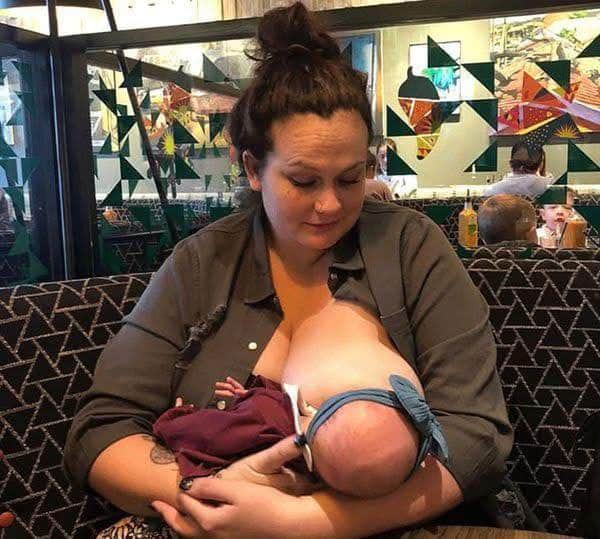
It happened on a sweltering summer afternoon in 2018, the kind of Texas day where the air seems to hum and even the shade feels warm. Melanie Dudley, a new mom from the Lone Star State, slipped into a restaurant with her family, found a seat, and did what millions of parents do every day: she fed her baby. Her son was three months old—tiny, fussy, and hungry—and Melanie began to nurse him as discreetly as she could, turning slightly away from other diners and using her body to block the view.
A man at a nearby table noticed and decided to offer an unsolicited instruction: could she “cover up”? There was no scene, no raised voices. Just a familiar pressure many nursing parents recognize—the demand to be invisible while doing something perfectly ordinary and necessary.
Melanie answered with a sense of humor that landed like a mic drop. She reached for the nursing cover, looped it over her head—not her chest—and let it drape down like a hood. The baby remained uncovered so he could eat comfortably, but Melanie sat there with the fabric tented over her hair and face, eyes peeking out beneath the hem. The visual gag was immediate. Nearby diners laughed; the tension broke. Her point was crystal clear without a single sharp word: if anyone needed covering, it wasn’t the hungry newborn.
A friend snapped a photo. In the image, Melanie is seated with the cover shrouding her head, her posture relaxed, her expression a mix of amusement and resolve. That one picture ricocheted across Facebook and other platforms, racking up shares and comments by the thousands. Some people applauded the playful clapback; others debated the etiquette of feeding infants in public. A few insisted she should have left the table, sought a restroom, or used a bottle. But most who weighed in recognized what actually happened: a mother cared for her child, was challenged for it, and responded with wit rather than anger.
The setting mattered. It was 86 degrees outside that day, and anyone who has nursed a baby in heat knows that fabric over a feeding infant isn’t just awkward—it can be uncomfortable and even stifling. Nursing covers are optional tools, not requirements. Some babies accept them, many refuse them, and parents learn quickly that the most reliable way to keep a little one calm and latched is to minimize distractions and discomfort. Melanie’s solution—“I’ll cover my head instead”—was a cool-headed reminder that a baby’s needs come first.
The photograph did more than amuse. It revived a perennial conversation about breastfeeding in public that never seems to fade, even though the legal landscape in many places is clear. In Texas, for example, mothers are allowed to breastfeed their children anywhere they are otherwise legally permitted to be. That protection reflects a simple principle: feeding a baby isn’t lewd, indecent, or impolite—it’s normal care. Beyond the law, health organizations have long emphasized the importance of making feeding—breast or bottle—safe, supported, and free from stigma. The World Health Organization encourages exclusive breastfeeding for the first six months when possible, and pediatric associations in the United States support breastfeeding for at least the first year and as long as parent and child desire. None of those recommendations come with an asterisk that says “only at home.”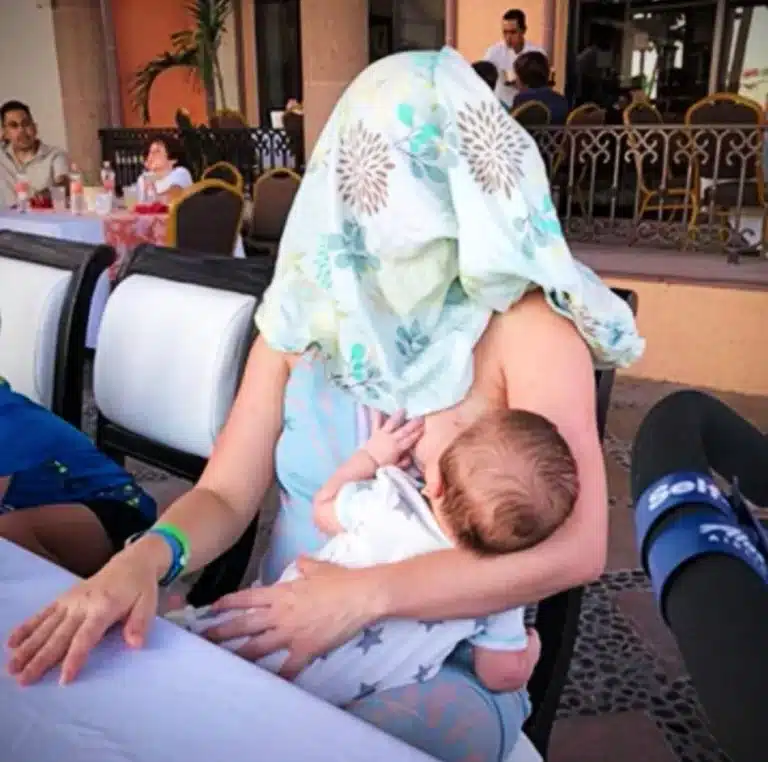
What made Melanie’s moment stick in the public imagination wasn’t just the law or the health guidance—it was the tone. She didn’t scold or escalate; she used humor to flip the script. It showed a path that can be easier to walk in daily life: rather than absorbing shame or retreating to a bathroom stall (a request we would never make of someone eating a sandwich), a parent can answer bad manners with grace and a wink—and keep feeding their child.
The online response also revealed how many people have stories like hers. Parents wrote about being asked to cover up in cafés, parks, even at family gatherings. Some were encouraged to feed in restrooms; others were told to use parking lots or cars. Many shared that thin, embarrassed feeling that creeps in when a stranger polices your body mid-feed. And then, post by post, they described what they wished had happened instead: a smile, a menu dropped off, water offered for the nursing parent, or—most often—nothing at all. Because the quickest way to “fix” a moment like Melanie’s is not to create one in the first place.
There’s also a practical piece that the viral photo helped highlight: “discreet” looks different for every dyad. Some babies latch quickly and stay under a light cover if it’s offered; others pop on and off, flail, kick off cloth, and demand both hands free and a clear path. Parents learn the choreography that works for their child. Outsiders rarely see the whole invisible dance.
For businesses and bystanders, the takeaways are refreshingly simple:
If you see a parent feeding a baby, carry on. It’s not a spectacle; it’s a snack.
If you’re a manager or staff member and a customer complains, support the parent. Offer to move the complainer, not the family.
If you want to be kind, ask whether the parent needs water or an extra napkin the same way you would with any other guest.
For families, Melanie’s story can be a quiet confidence boost. You’re allowed to feed your child, wherever you are lawfully present. You don’t owe strangers an explanation, and you don’t need to perform gymnastics to satisfy someone else’s comfort. Use a cover if you and your baby like it. Skip it if you don’t. Nurse, bottle-feed, combo-feed—do what works for you.
Years after the photo made the rounds, the image still pops up periodically with the same mix of laughter and relief. It’s disarming because it re-humanizes a conversation that so often gets moralized. The reality is prosaic and tender: a tiny person needed to eat, and the person who loved him most made sure he did. No shame required. No curtain demands. And if humor helped the lesson land without turning the restaurant into a battleground, that’s a win for everyone.
In the end, Melanie’s gesture wasn’t a stunt. It was a boundary drawn with a smile. It said: I hear your discomfort; I won’t absorb it. I’m feeding my child. You’re welcome to finish your lunch. And to the many parents who saw themselves in her—sweaty, tired, alert to every fuss and flail—it said something else, too: you’re not alone, and you don’t have to apologize for meeting your baby’s needs.
That’s the part that keeps the story relevant. Long after the likes fade and the comment threads are archived, families will still be out in the world trying to keep small humans fed and happy. They deserve the same thing every diner, shopper, and passerby wants: a little respect, a little space, and the benefit of the doubt. And, when necessary, a laugh to cut the heat.