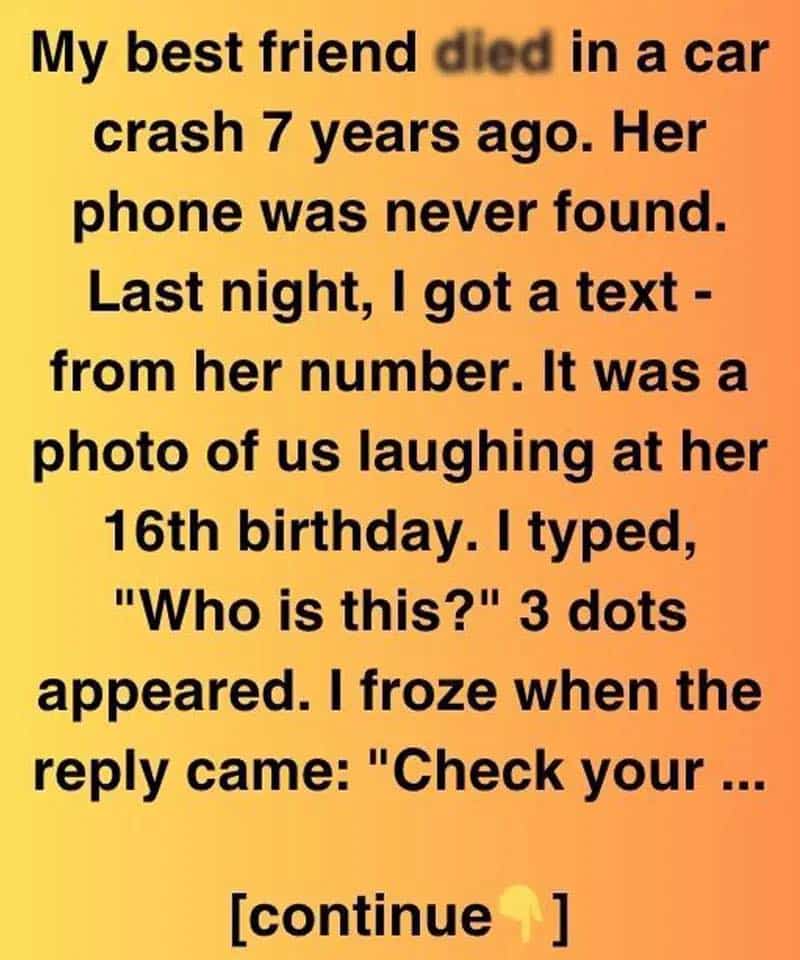
Seven years after the crash that took my best friend, Adira, I was in bed scrolling when my phone lit up with a text from her number. A photo popped in first: the two of us at her 16th birthday, frosting on our noses, laughing like nothing bad could ever happen to us.
My thumbs hovered. I typed, Who is this?
Three dots. Then: Check your mailbox.
Midnight had buttoned the neighborhood shut. I live at the end of a quiet cul-de-sac where even the porch lights yawn early. Thirty steps to the curb felt like a pilgrimage. I went anyway—barefoot, mismatched pajamas, hoodie up—like an extra in a horror movie who doesn’t know better.
Inside the box was a single manila envelope, no stamp, my name on the front in blue gel pen—the exact kind Adira used to hoard.
My heartbeat climbed into my throat. I opened it on the sidewalk with shaking hands.
Five printed photos slid into my palms. Choir trip, ninth grade. Her mom’s rooftop, summer of bad bangs. The night we lied about our age and got into that foam party, grinning like we’d pulled off a heist. Then one that didn’t belong to any old album: me at my cousin’s wedding last year, blue clearance-rack dress, mid-laugh, taken from behind a pillar.
I was inside before I noticed my hands were cold. Deadbolt. Chain. I called the number.
One ring. A voice: “Hey. It’s me.”
I almost dropped the phone. “Who is this? This isn’t—”
“It’s Adira.” Softer, like she was trying not to scare a stray cat. “I can explain. But I need to see you.”
My mouth was dry. I knew that voice in the same way you know your own name. She told me to meet her at the old lookout, the cliff where we used to share contraband wine coolers and loud opinions at seventeen. Then she hung up.
I didn’t sleep. At 4:30, I drove. Dawn had only smudged the edge of the sky. A silver car idled by the guardrail. Someone sat on the hood, hood up, ankles crossed.
She looked up. My keys hit the asphalt.
Same dark curls. Same freckle just above her lip. Same tired, knowing eyes.
“You died,” I said, because that’s all my brain had.
She nodded. “I was supposed to.”
I stood there shivering until she patted the hood beside her. Sit. Please.
She told me why.
The night of the crash, she wasn’t alone. She’d gotten into a car with a man she shouldn’t have been with—Mateo, older, married, dangerous in the clean-shirt way. They fought. He drank. The car rolled twice down a ravine. She crawled out. He didn’t.
“I panicked,” she said. “My head was bleeding. My phone was gone. I thought I killed him. I didn’t know how to be the person who calls the police and waits.” She didn’t trust anyone, not even me. She walked. Hitchhiked. Dyed her hair in a motel sink. Swapped names like coats. Oregon, New Mexico, Oklahoma—she drifted and watched my life from the shadows. When I got into nursing school. When my dad got sick. She wanted to reach out. Fear kept her under.
“Why now?” I asked, watching the sun pull the valley into color.
“Leukemia,” she said. “Late-stage.” Her voice trembled for the first time. “I wanted you to hear the truth from me. And… I need a favor.”
That afternoon we drove into the city. She wouldn’t say where until we parked in front of a brick duplex in East Haven. A woman came out holding a little boy’s hand. He was five at most, big brown eyes, cautious smile.
“This is Layla,” Adira said. “And that’s Kian. My son.”
My breath stalled. Layla was his foster mother. She’d taken him when Adira collapsed at her diner job and the hospital learned she had no “next of kin.”
“I don’t want him in the system,” Adira said, voice thin. “I don’t want him to be alone when I’m gone.” She looked at me. “Unless you… unless you’d want…”
Only if you want to. Only if you can. The words hung there like a rope across a canyon.
The next weeks blurred into paperwork and home visits and the kind of conversations that make you measure yourself. Kian came over for dinners, then weekends. He loved dinosaurs and puzzles and drawing maps that made sense only to him. When he called me Tita Rana for the first time, I sat in my car afterward and cried until the steering wheel fogged.
Adira and I spent every hour we could together, careful with the remaining pieces. We baked terrible brownies. We watched old movies with the volume too low. We drank ginger tea and traded silence. We mostly didn’t talk about the missing years. We built a small, fierce present instead.
She didn’t get better. But she stayed longer than anyone promised. One night we watched a grainy video from our choir trip, voices wobbling through harmonies, faces bright with the kind of joy that doesn’t know its expiration date. Her fingertip hovered over the screen.
“You were always the best part,” she whispered.
She died the next morning, in her sleep, her face soft with relief.
It’s been two years. Kian started second grade last week. He’s obsessed with robotics and makes Lego cities with functioning traffic systems. He keeps a photo of Adira in his backpack and a tiny plastic stegosaurus in his pocket because it “protects him from bad dreams.” Every night we light a candle for her and take turns telling her about our day—what he learned, who I helped at work, whether the neighbor’s cat stole our porch chair again. Sometimes, when he colors, he hums the same tune Adira used to sing while she flipped pancakes. It’s almost muscle memory—love rethreading itself through the present.
I kept her number. Her first text sits pinned at the top of our thread. Sometimes I drive to the lookout and sit on the hood and watch the light show happen again. I don’t feel haunted there. I feel… chosen. Like whatever detour she took still pointed me home.
Adira wasn’t a saint. She ran when she should have called. She let fear make her small. But when it counted, she told the truth and handed me her heart in the shape of a boy with brown eyes and a dinosaur in his fist.
Losing her gave me a bigger family, a thicker kind of love, and a forgiveness I didn’t know I was capable of. People vanish. They return. They break you open in ways that let more light in.
So if an old number pings your phone with a piece of your past, listen. It might not be a ghost. It might be someone finally brave enough to come home.
If this tugged at something in you, send it to the person you miss. Someone out there needs the reminder that second chances do exist.