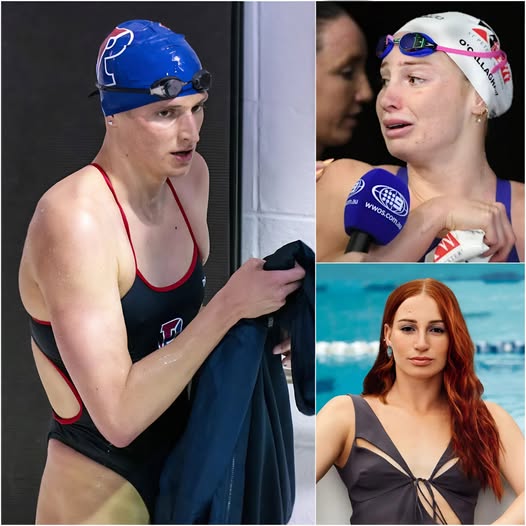
In a bombshell move that’s already sending shockwaves through the global sports world, the Australian Sports Commission has officially pledged its full support to swimming star Mollie O’Callaghan — and delivered a stark warning: Australia may boycott the 2028 Olympic Games if transgender swimmer Lia Thomas is allowed to compete in women’s events. The commission justifies the threat by citing concerns about what it calls “inherent biological imbalances.”
As the controversy ignites fresh debate around fairness, inclusion, and the policies that govern elite sport, the commission’s ultimatum raises critical questions: how far will national bodies go to protect perceived competitive integrity? And can such a bold stance actually be enforced?
The Commission’s Declaration & Justification
According to the widely circulated statement, the Australian Sports Commission (ASC) affirmed that O’Callaghan — one of the nation’s most decorated rising swimming stars — must not be placed in a position where her results are potentially undermined by what the commission describes as intrinsic physiological disparities. The ASC claims these disparities persist even after hormonal treatment and thus produce a fundamentally uneven playing field.
“By insisting on enabling Thomas’s participation in women’s events, the integrity of female competition is jeopardized,” the statement reads. It further warns that if global governing bodies allow such participation, Australia may see no alternative but to skip the 2028 Games, essentially using its Olympic presence as leverage in a fight for stricter eligibility rules.
This sort of ultimatum is rare in Olympic politics, and if carried through, would represent one of the strongest national-level protests against transgender inclusion in sport to date.
A Closer Look at O’Callaghan & Thomas
Mollie O’Callaghan is no stranger to the spotlight. At just 21, she already has multiple Olympic golds and is considered one of Australia’s brightest hopes for Paris and beyond. In recent months, she’s been embroiled in speculation over whether her name has been used to lend false weight to divisive statements on transgender athletes.
Meanwhile, Lia Thomas — a U.S. swimmer and a transgender woman — has been central to longstanding debates around inclusion in elite sport. Under the 2022 guidelines by World Aquatics, athletes who have undergone any part of male puberty are currently barred from competing in women’s categories at the highest international level. theguardian.com Thomas previously challenged such restrictions but was denied by arbitration, effectively ruling her out of events like the Olympics under current rules.
Thus, critics point out that the commission’s threat sounds hollow: Thomas is already ineligible under existing regulations, making the boycott warning appear more symbolic than practical. transvitae.com+2ausleisure.com.au+2
Fallout, Rebuttal & the Misinformation Angle
Complicating the entire situation is a growing body of evidence suggesting the original quote attributed to O’Callaghan was fabricated. Swimming Australia has publicly denounced the statements as “fake quotes” circulating on social media, affirming that O’Callaghan has never spoken publicly about transgender athletes. ausleisure.com.au+2amp.nine.com.au+2 They have formally asked platforms like Meta to remove the misleading posts. ausleisure.com.au+1
If indeed the ultimatum has no authentic attribution, the scenario becomes even more troubling: national bodies amplifying or legitimizing misinformation may worsen divisions and erode trust in public discourse.
Broader Implications & What’s at Stake
Should the ASC follow through on its threat, the consequences would be profound:
-
International backlash: The International Olympic Committee (IOC) and global federations would come under intense pressure to respond, possibly triggering formal investigations or sanctions.
-
Polarization: The move would deepen rifts between inclusion advocates and traditionalists within sport, at a time when many voices are calling for nuanced policies and fairness frameworks.
-
Reputational damage: Australia’s commitment to equality and fair play could be questioned, especially if the ultimatum proves rooted in misinformation or misattribution.
-
Precedent-setting: Other nations might adopt similar posturing, using Olympic participation as a political bargaining chip.
Final Thoughts
At its core, the headline “Australia may boycott 2028 over Lia Thomas” reflects far more than a surface-level controversy. It touches on the fault lines between science, ethics, and human rights in sport. But as the facts currently emerge, the situation appears entangled with disinformation and emotional grandstanding. Unless clarified and retracted, this episode could become a regrettable case study in how fragile the boundary is between media spectacle and genuine policy debate.
Post Views: 76