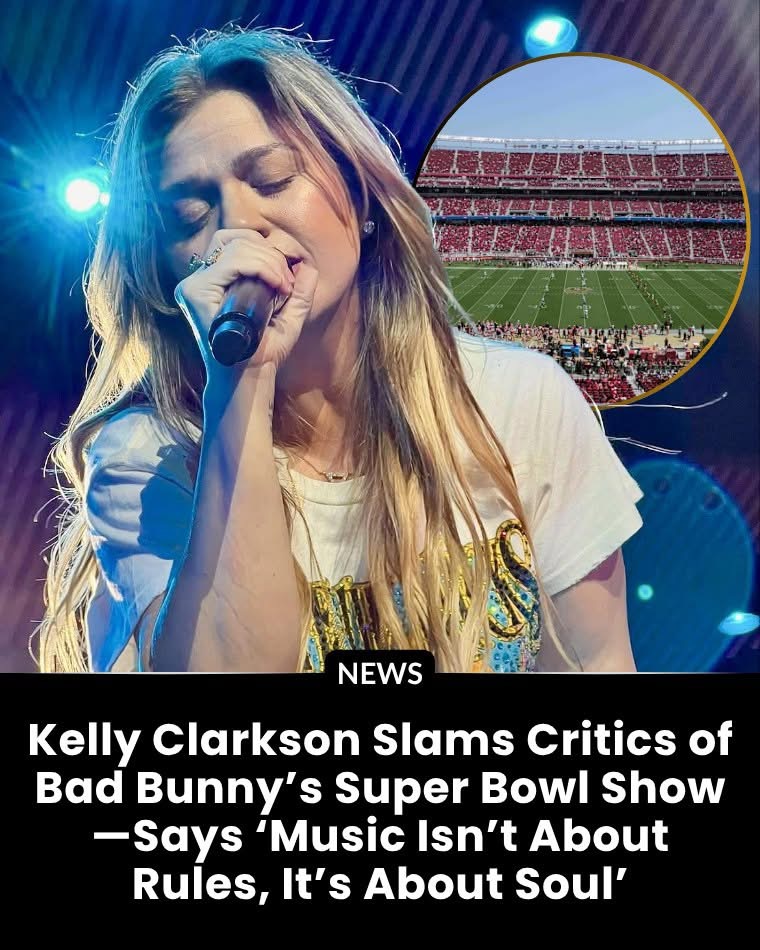
Kelly Clarkson Slams Super Bowl Critics: “When Did We Stop Enjoying Music for the Pure Joy of It?”
HOLLYWOOD, CA – The annual post-Super Bowl chatter usually revolves around the game’s outcome or the best commercials, but this year, much of the media debate has centered on the cultural implications of Bad Bunny’sappearance—specifically, his decision to perform largely in Spanish. As a vocal backlash emerged, with critics arguing the performance was inappropriate for “America’s biggest stage,” talk show host and original American Idol Kelly Clarkson delivered a passionate, signature rebuttal that cut straight to the heart of the matter.
Clarkson, known for her candid nature and deep respect for musical artistry, used her platform to fiercely defend the global nature of music, questioning the motives of those who found offense in the use of a non-English language.
A Challenge to Musical Gatekeepers
“Honestly, I’m so sick of the fighting,” Clarkson said during a recent segment, addressing the controversy with palpable frustration. “I was watching the Super Bowl and I loved the Halftime Show, and then I get online and it’s all this ridiculous anger about Bad Bunny singing in Spanish. My only question is: When did we stop enjoying music for the pure joy of it?”
Her comments directly targeted the underlying sentiment that American cultural events should be strictly monolingual. Clarkson argued that music’s power transcends language barriers, citing the massive worldwide appeal of artists who sing in various tongues.
“We listen to opera in Italian, we listen to K-Pop in Korean, we dance to global hits that we don’t necessarily speak the language of, because the beat and the feeling is universal,” she asserted. “If you felt the rhythm and you were having a good time, what difference did the dialect make? That is a form of gatekeeping, and it’s frankly exhausting.”
Rethinking “America’s Biggest Stage”
Perhaps the most potent part of Clarkson’s defense was her challenge to the very idea of what the Super Bowl Halftime Show—often marketed as “America’s biggest stage”—is supposed to represent in the 21st century.
She pointed out that the United States is a nation of immigrants and diverse cultures, and that the audience for the Super Bowl is global. By featuring artists like Bad Bunny, who is one of the world’s most-streamed musicians, the NFL is accurately reflecting a modern, interconnected world, not catering to a narrow definition of “American.”
“When people say it’s ‘America’s biggest stage,’ I agree. And what does America look like? It looks like Puerto Rico, it looks like Mexico, it looks like Europe, it looks like everywhere,” Clarkson stated. “America is not one language, and to tell a major global artist to change his language for a three-minute spot is the least American thing I can imagine. The power of that stage is showing the world who we are, and we are diverse.”
Clarkson’s intervention serves as a powerful reminder that while the culture wars rage on, music remains a unifying force. Her clear-eyed perspective advocates for a return to appreciating art based on its emotional impact and artistic merit, rather than using it as a battlefield for political and linguistic debates.
What are your thoughts? Does Clarkson’s defense ring true for the future of live music events?
Post Views: 49