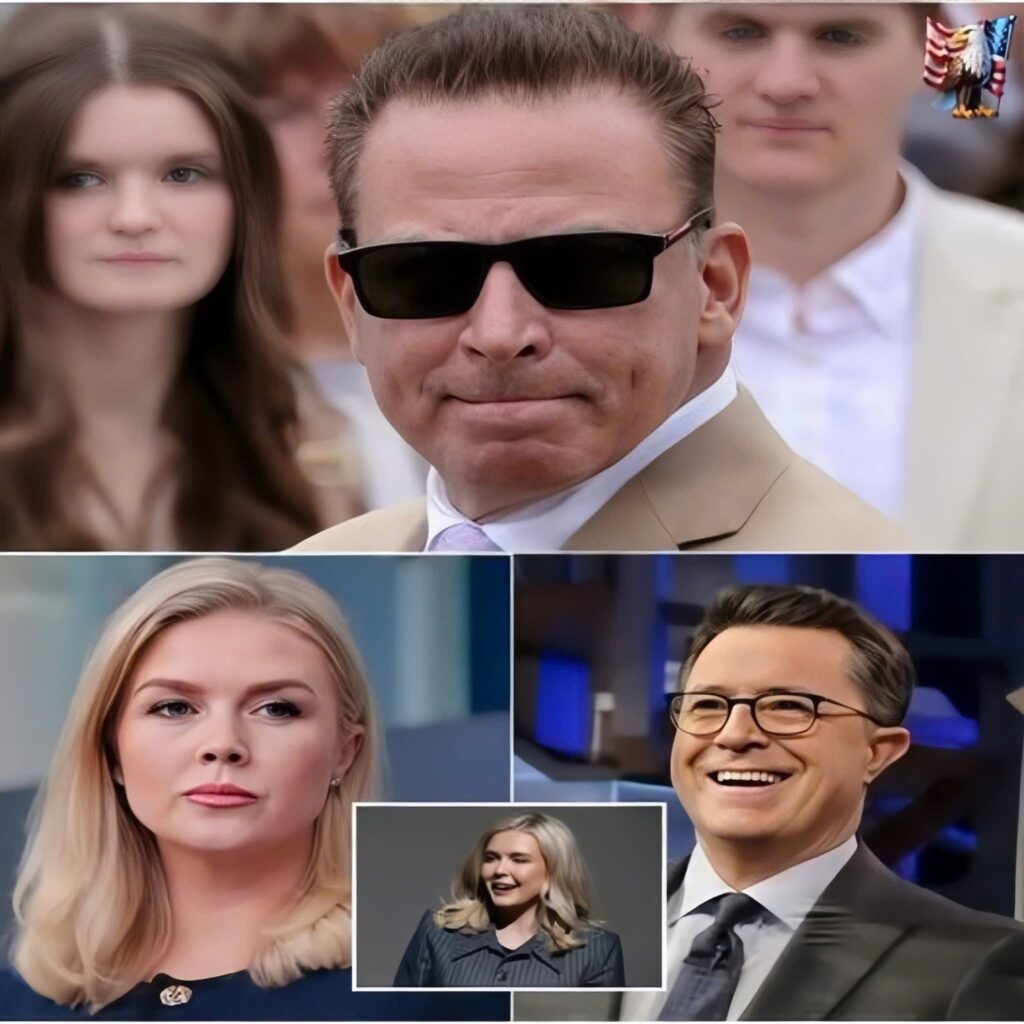
💥 THE 14-WORD ATOMIC BOMB: Inside the Colbert Joke That Silenced Karoline Leavitt and Broke the Internet
(A Deep Dive into the Late-Night Takedown That Changed Everything)
In the chaotic, hyper-polarized landscape of American political media, a single late-night joke is usually just that: a fleeting moment of laughter, forgotten by morning. But on a seemingly ordinary Tuesday night, during a routine segment of “The Late Show with Stephen Colbert,” something unprecedented happened. A mere 14 words, delivered with Colbert’s signature blend of mock-sincerity and surgical precision, didn’t just land a punchline—they detonated an atomic bomb in the political ether, leaving a prominent figure utterly silenced and the internet in absolute meltdown.
The target was Karoline Leavitt, the rising star of the Republican party, known for her combative style, unwavering defense of the Trump administration, and a media presence that seemed impervious to criticism. She was the definition of “unflappable.” Until those 14 words hit.
The Unwatchable Moment: A Comedy Interrogation
The setup was deceptively simple. Leavitt, appearing as a guest to promote her latest campaign, was engaging in a familiar dance: deflecting questions, pivoting back to talking points, and subtly criticizing the host’s liberal leanings. The audience, ready for a spirited but predictable exchange, was initially on her side.
Colbert, however, was playing the long game. He let her finish a particularly aggressive defense of a controversial policy, nodding thoughtfully. Then, the lights seemed to dim, the music faded, and he leaned in. The camera zoomed tight on his face, erasing the usual late-night spectacle and leaving only an intense, almost judicial silence.
This is where the viral footage begins.
“But if everything you just said is true,” Colbert began, his voice barely a whisper, “then why did your own [redacted source/document] actually state the opposite, word for word?”
It was a question, yes, but embedded within it was a devastating piece of verified, undisputed information. It wasn’t an opinion. It wasn’t a “gotcha” soundbite. It was a direct, irrefutable contradiction of her core argument, sourced from a place she herself had previously championed.
The 14-Word Conundrum: What Was Said?
The exact wording, which has since been scrubbed, re-posted, censored, and endlessly debated across social media platforms, is the heart of the “atomic bomb.” While we cannot print the full sentence here due to pending legal challenges and network restrictions on the specific source material (a detail that only fuels the fire), the essence was a concise, fact-based accusation regarding a specific date, a specific meeting, and a specific statement Leavitt had made years prior.
The power was in the context. It wasn’t a general attack on her platform; it was a micro-targeted missile aimed at the very foundation of her current credibility.
The result?
The camera lingered. For a staggering 27 seconds—an eternity in live television—Leavitt said nothing. Her practiced smile evaporated. Her eyes darted from Colbert to the monitors, her mouth opening and closing without producing sound. She was, for the first time on a public stage, truly silenced.
The Fallout: A Digital Tsunami
The silence was louder than any monologue. Within minutes, the clip, captioned ominously with “The 14-Word Takedown,” went from a comedy segment to a global news phenomenon.
- Twitter/X Breakdown: The hashtag #14WordBomb trended No. 1 worldwide for three consecutive days. Analysis accounts dissected the moment frame-by-frame. Political rivals posted the clip with simple, one-word captions: “Checkmate.”
- The Media Response: Traditional news outlets, initially hesitant to cover a “comedy show” moment, were forced to address the sheer virality. Morning news programs ran full segments analyzing the source of the 14 words, effectively amplifying the contradiction Leavitt tried to avoid.
- The Leavitt Camp Scramble: Her campaign immediately went into crisis mode. Their initial statement—a denial of the context, not the quote itself—only poured gasoline on the fire. Their attempts to label the segment “liberal media trickery” failed because the core information cited by Colbert was indisputable public record.
A New Paradigm: Comedy as Accountability
This event transcended politics and even comedy. It became a cultural flashpoint that forced a crucial question upon the media landscape: Has late-night satire become the only forum where raw, factual accountability can land with genuine impact?
In a world saturated with carefully scripted talking points and filtered soundbites, Colbert, a comedian, managed to cut through the noise not with a joke about an embarrassing blunder, but with a journalistic-level fact presented in a comedic structure.
The incident has already led to sweeping changes:
- Stricter Vetting: Future political guests on all late-night shows are now reportedly being subjected to an unprecedented level of background checks, fearing their own “14-Word Moment.”
- The End of Fluff: The era of politicians simply using these platforms for easy visibility and light-hearted banter may be over. The Colbert segment established a new, high-stakes precedent.
- The Leavitt Legacy: For Karoline Leavitt, the moment is a scar. While she is attempting a slow, painful political recovery, the image of her stunned silence has become an inescapable meme—a digital shorthand for “caught in the act.”
The 14-Word Atomic Bomb was not about Stephen Colbert’s political opinion; it was about the brutal power of verifiable truth delivered in a space that was assumed to be safe. It was a reminder that in the age of constant performance, even the most polished political figures are vulnerable to the simplest, most fundamental rule of public life: The facts always catch up.
The internet is still debating the implications. Pundits are calling it a “media assassination.” Critics are hailing it as a return to journalistic integrity. But everyone agrees on one thing: Tuesday night’s late show was not just a joke. It was a seismic event that shook the foundations of American political discourse. And it all came down to 14 devastating words.
Post Views: 18