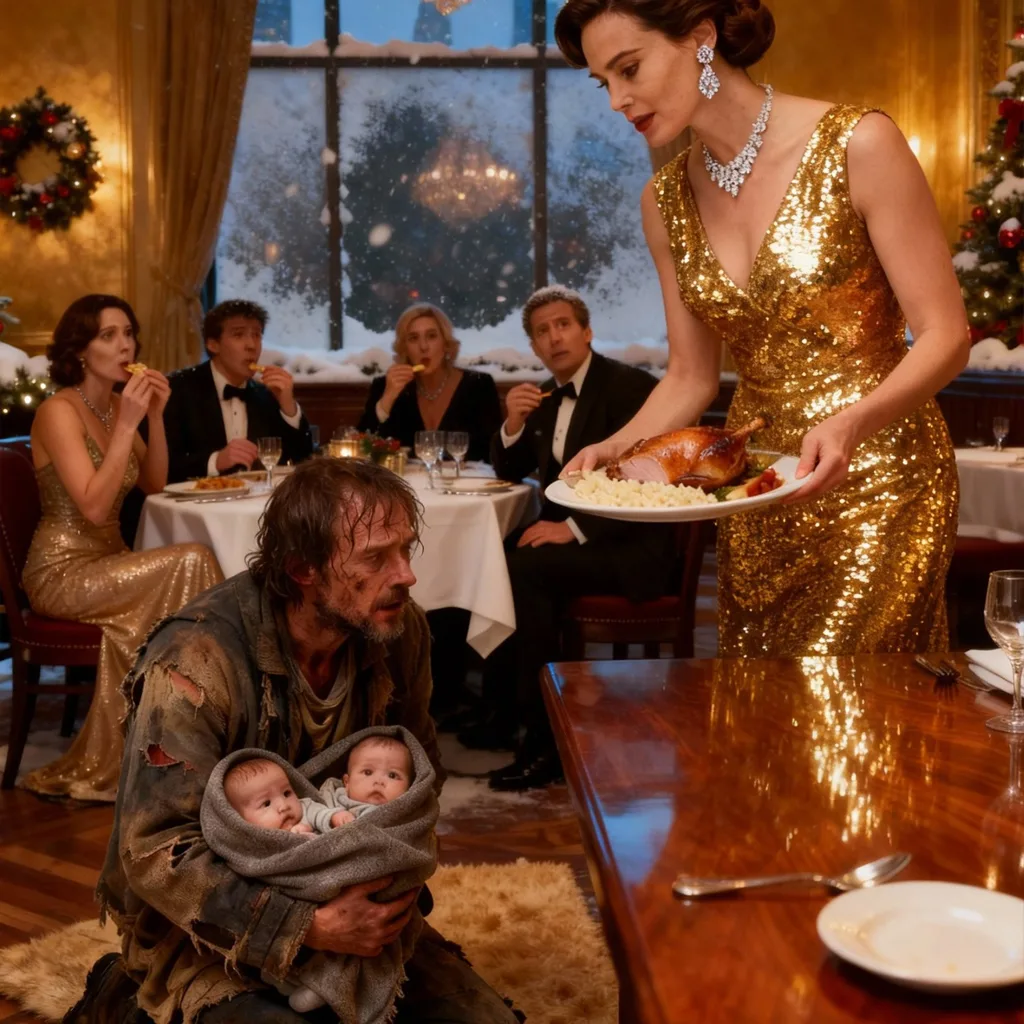
Snow fell like patient ash, soft and unhurried, turning Fifth Avenue into a corridor of muffled light. The Silver Birch held itself apart from the weather, a warm box of crystal and linen where time behaved and the staff moved like choreography. Clara Whitfield sat alone at a corner table, the kind with a view of the room and the street, her steak cooling into a shape she could no longer name. Laughter rose and fell in curated waves. A string quartet stitched the air together with something pretty and forgettable. Her bracelet threw off cold light as she turned her wrist and realized she couldn’t feel the weight of anything she wore.
Then the door cracked open and winter itself stepped inside. A man was kneeling on the threshold, snow clinging to his coat like salt, breath fogging the air. In his arms, bundled in a torn gray blanket, were two children whose faces were an unsettling blue at the lips. He was not dramatic about it. He didn’t raise his voice. “Ma’am,” he said into the hush, “please… can we have your scraps?”
For a moment, no one moved. Money has a sound; it went quiet. Someone whispered, “Security.” Clara was already standing, the chair’s legs grating against the marble like a correction. “No,” she said. “Bring them here.”
The waiter hesitated, then guided the man toward her table. The children’s eyes tracked the plates like planets. Clara slid her dish forward. “Please,” she said.
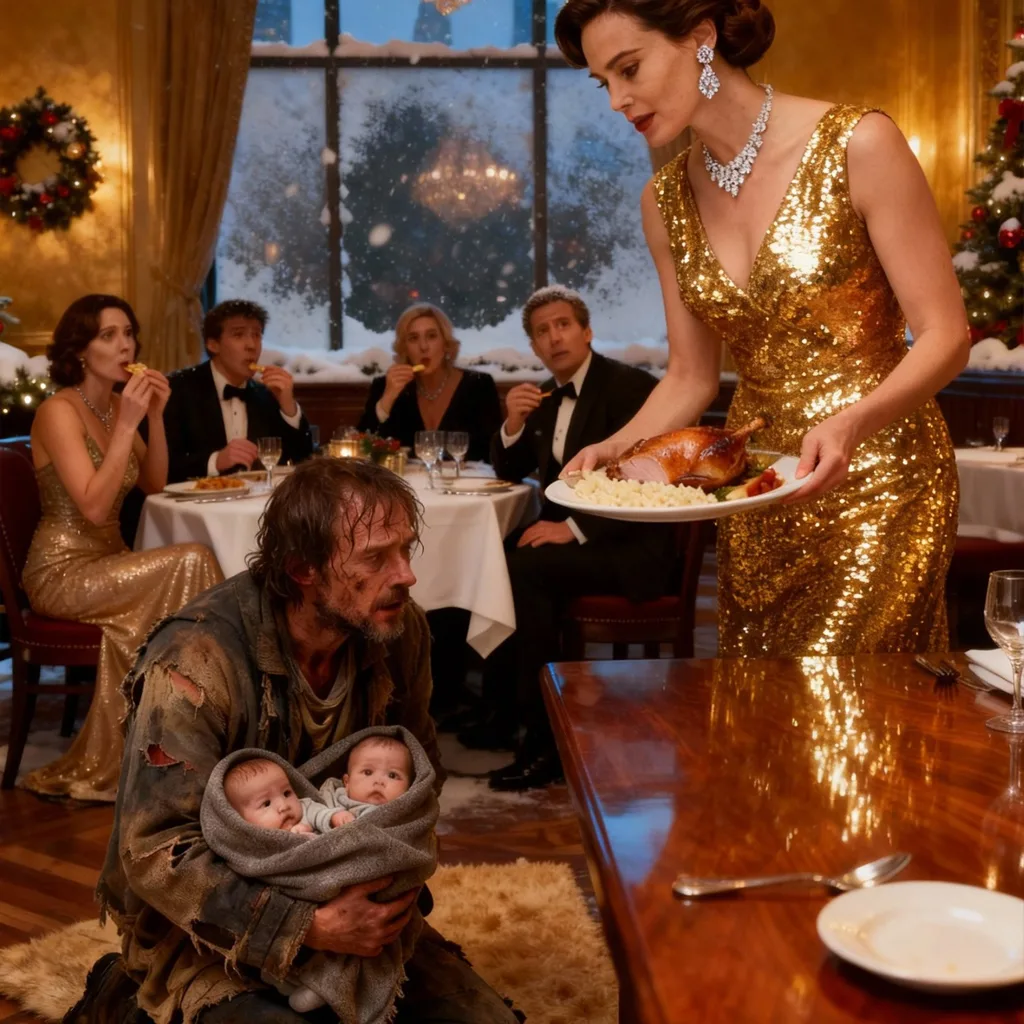
He shook his head in a gesture that looked older than he was. “For them,” he whispered. He tore bread in careful pieces with hands that shook from cold and something else, and fed each child by turns. He didn’t take a bite until every small mouth had swallowed and settled. Phones lifted around them like periscopes. People looked and then away. Clara did not look away. There was nothing performative in his tenderness. It was work, fierce and ordinary.
When the plate was empty, he placed the fork as if respecting a ritual he didn’t belong to. “Thank you, ma’am. We’ll go.” She reached into her bag and offered cash, a reflex in a city that likes solutions that fold. He shook his head again. “You’ve done enough.” He gathered the blanket, rose with effort, and disappeared back into the snow as if the door had swallowed him.
Clara’s pulse was suddenly there, loud in her ears. The quartet played something that felt like the past. The food on nearby tables looked like props.
Clara Whitfield had built a life of surfaces so flawless they passed for depth. Daughter of a banker who retired early and a mother who kept her social calendar like a ledger, she’d made a brand out of restraint. Her fashion house sold the promise of impeccable control—clean lines, fabrics that didn’t wrinkle, zippers that behaved. Manhattan loved her for the way she delivered a dream without admitting it was one. Awards lined a hallway no one used. The penthouse sat above the city like a hand over a candle, taking light, giving none.
What no one knew, or what they pretended not to know, was that everything soft inside her had been sorted into unlabeled drawers. The long-ago griefs—the brother who didn’t make it to spring, the first love who thought her ambition had room for him—had taught her that uncomplicated was a fortress and loneliness a tax deductible. She had friends who dressed like allies and allies who dressed like friends. Her calendar glittered with openings, galas, rooms where questions were for sport and answers were rehearsed.
Meaning had thinned to a clear broth. She could feel it most at charity events where applause measured generosity and donations arrived with embossed names. She’d written checks big enough to move needles and noticed nothing had pierced her. Some people get used to hunger because it arrives as a companion and not an emergency. Clara’s life was a table set with everything but appetite.
That night at The Silver Birch, she had come from a board meeting full of talk about fourth-quarter projections and a collaboration with a photographer who was, if they were honest, a clever repetition. She had pushed her steak into quarters. She had lifted her wine like a salute to an absence she couldn’t name. And then a man had knelt in the doorway and rearranged the coordinates of the room.
On the sidewalk, the snow sharpened. Clara’s driver flinched at her voice. “James,” she said through the cold, “find him.” The town car moved like a black fish through the white. Ahead, a figure shuffled, curved around his children like shield and shelter. He turned down a side street, then into an abandoned subway entrance that held the kind of cold you can’t decorate.
Clara stepped out. Her stilettos punched clean holes into the crusted snow. “Sir,” she called, not louder, just warmer. He turned, startled, as if he’d been caught doing something beautiful he was ashamed of. Up close she could see the angle of his hunger. “I want to help,” she said. He didn’t step closer or away. “Their names?” she asked.
“Grace,” he said, touching the smaller cheek with a reverent finger. “And Sam.” His voice carried a fatigue that had filed itself into all his words. “Their mom died last winter. I’m Evan. I can’t find work. Shelters are full. I’m trying.”
Clara slid off her gloves and tucked them over the children’s hands. The act felt ridiculous and also not. “You’re not staying here,” she said with the confidence of someone used to rearranging outcomes. He almost smiled, a brief surrender to the fact that some sentences can be true simply because someone decides they are.
At a small hotel off 45th, Clara signed without reading and requested too many blankets and soup hot enough to feel. She watched as Evan fed them first, again, sitting on the edge of the bed the way people sit on decisions. Grace fell asleep with a crust in her hand. Sam leaned into the sound of heat. Evan cried without drama, tears moving quietly in the groove time had carved in his face. “Thank you,” he said, like a person paying a debt he understood would only grow. “Merry Christmas,” she said back, surprised at how it felt in her mouth.
She went home to a penthouse that had learned her shape. Floor-to-ceiling windows turned the city into a dome of light. She watched snow erase the edges of streets. For years she had pursued a version of having that required no one. She stood in her own living room and understood that she had been practicing a deprivation so refined she could frame it. The man had asked for scraps. She had been living on them.
Morning arrived with the granular light of a city that doesn’t sleep so much as blink. Clara called her financial advisor and said, “I want to start a foundation. Families like his. Food, housing, medical care, legal help, job placement—things that hold.” He cleared his throat and reached for language that would not sound like an argument. “It’s a significant outlay,” he said finally. “It’s the first thing I’ve bought that isn’t for show,” she replied, and hung up before he could translate that into an asset class.
Paperwork moved fast when signatures were decisive and money had a place to go. The Whitfield Foundation for Families opened in a modest building that used to be a tax office. She hired social workers who had stayed when other people left, a nurse who could find a vein without bruising it, a lawyer who kept a suit at his desk for court dates that blew in like weather. The lobby was plain and warm. A bulletin board bloomed with phone numbers for services that actually answered. The coffee was decent. The bathroom had spare diapers. The mission statements were printed small and the intake forms shorter than anyone believed possible.
Evan came by with Grace and Sam once the snow melted into city slush. He had work by then, part-time first, then steadier, the kind of job people don’t brag about and then secretly depend on—warehouse, night shift, practical shoes. The foundation covered first-and-last on a small apartment with a radiator that sounded like a friendly ghost. A case manager walked him through the bureaucracy that had tangled him, and a pediatrician registered the children as if naming them into safety. Clara visited on a Tuesday, not because it was a holiday but because it wasn’t. She brought a bag with no brand on it, filled with books and socks. Grace showed her a drawing of a house with four windows and a sun that took up most of the page. Sam held onto the hem of his father’s coat and stared as if memorizing.
Each Christmas, Clara carved time out of a calendar that no longer frightened her and ate where the table lived, not where it looked good. Evan would say thank you as if the words had learned to walk, and Clara would shake her head, not as modesty but as comprehension. “You pulled me back,” she’d say. “I was very far away.”
The foundation grew in measured ways. It refused cameras unless there was policy to discuss. It collected stories but did not display them. People came and people left and sometimes people didn’t make it, and the board learned how to talk about that in sentences that didn’t convert loss into a lesson. Clara’s apartment felt less like a museum and more like a room where a person might actually sit. The bracelet still sparkled. She wore it less.
The city loves epiphanies that fit inside a holiday card: a rich woman saved by a poor man’s virtue, the heart warmed, the check written, the problem resolved. That version is neat and useful and cheap. What happened to Clara was stranger and slower. It wasn’t generosity performing itself; it was need recognizing need across a polished table and a cold threshold. A man knelt not to beg but to keep his children alive in a room built to forget what hunger looks like. A woman with everything realized how little of it could be eaten.
The priceless gift was not gratitude and not even purpose, though purpose did arrive like warmth after shivering. It was the shock of connection, the jolt of seeing love practiced without surplus. Evan’s refusal of money in that first moment wasn’t pride; it was order. First the children eat. Then the rest of the world can resume.
Clara did not become someone else. She became more specific. She learned to spend differently: not just money, but attention, time, reputation. The miracle wasn’t the foundation. It was the way she let it revise her days—the meetings she missed so she could sit in a waiting room, the dinners she declined when a case worker said, “We might need you at court,” the silence she kept when a story wasn’t hers to tell. She had built a life around a table she never sat at. Now she knew what it meant to feed and be fed.
Outside the restaurant that first night, the snow braided the city into one thing. Years later, it would fall again, quieter as her mind was quieter, and she’d think of small hands warming inside her gloves, of soup ordered at midnight, of a man’s eyes when he realized there might be a door where there had only been a wall. She would understand that love worth keeping warm is not a sentiment but a practice, repeated until it becomes nature. The rooms stayed bright. The bracelets still threw light. But the only sparkle she trusted was the look on a child’s face when hunger ended for an evening and the world, briefly, made sense.