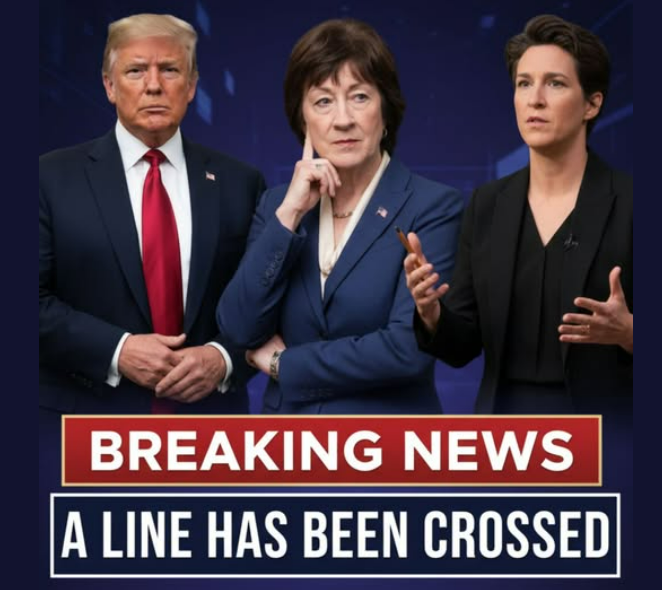
In late 2025 and early 2026, Congress has increasingly defied President Trump, passing measures that reverse or block his policy initiatives.
This includes votes on war powers, healthcare, and science funding, as detailed on “The Rachel Maddow Show.”
Maddow delivered the news with a sense of momentum, highlighting Republican defections as significant rebukes in a rapid-fire narrative.
The Senate advanced a War Powers Resolution to limit Trump’s military actions in Venezuela, with five Republicans joining Democrats.
Though ultimately blocked by a narrow vote after intense lobbying, it marked rare bipartisan concern over executive war authority.
Maddow emphasized the crossover, noting it as one of the “worst rebukes” Trump faced from his party.
The War Powers Act of 1973 requires congressional approval for prolonged military engagements, a response to Vietnam-era overreach.
Venezuela’s crisis, involving U.S. sanctions since 2019, escalated under Trump with threats of intervention.
The resolution’s initial passage reflected fears of unauthorized escalation, drawing from historical debates over Iraq and Libya.
In the House, 17 Republicans sided with Democrats to pass a bill extending Affordable Care Act subsidies for three years.
This countered Trump’s efforts to let enhanced credits expire, which could double premiums for millions.
Maddow portrayed this as a direct challenge, with Trump threatening a veto amid midterm pressures.
The ACA, enacted in 2010, has survived multiple repeal attempts during Trump’s first term. Subsidies, expanded under Biden’s American Rescue Plan, reduce costs for low- and middle-income families. The bipartisan vote highlights electoral vulnerabilities, with Republicans in swing districts prioritizing constituent needs.
Congress also rejected Trump’s proposed deep cuts to science agencies in the fiscal 2026 budget. The National Science Foundation faced a 56% cut proposal, reduced to under 1% by lawmakers. Maddow celebrated this as a bipartisan win, contrasting Trump’s demands with congressional increases for basic research.
NSF, founded in 1950, funds groundbreaking research in fields like AI and quantum computing.
Trump’s budget aimed to prioritize defense, but Congress maintained flat funding for NOAA, crucial for weather forecasting.
This echoes past budget battles, where science funding has been a bipartisan priority since post-WWII investments.
NOAA’s role in climate monitoring dates to 1970, with satellites aiding disaster prediction.
Rejecting a 33% cut to basic research preserves innovation, as seen in historical breakthroughs like the internet.
Maddow linked this to broader congressional dysfunction, noting rare productive actions against Trump.
Amid slim majorities, Republicans face midterm risks, with Democrats poised to gain seats. Senator Mary Peltola’s challenge to Dan Sullivan in Alaska exemplifies shifting dynamics. Maddow’s analysis used vivid language, like “one-finger salute,” to convey the rebukes’ intensity.
These actions signal eroding party unity, rooted in Trump’s polarizing style since 2016. While vetoes loom, they force Trump to own unpopular policies. In sum, Congress’s pushback maintains checks on executive power, fostering policy continuity amid political turbulence.