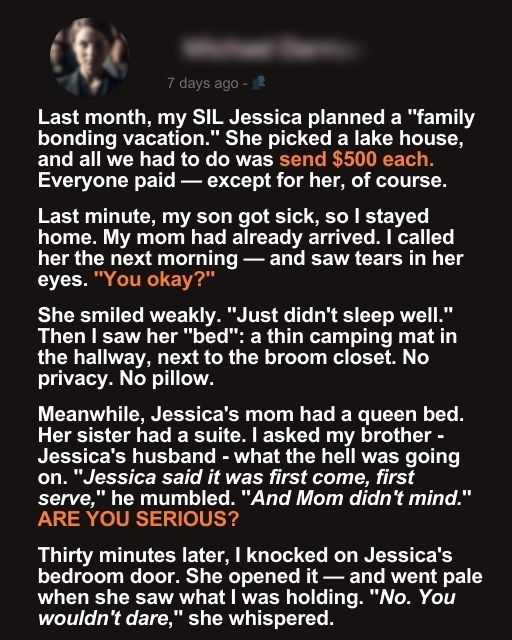
Last month my sister-in-law, Jessica, announced a “family bonding vacation.” She found a lake house that “totally sleeps everyone,” sent the link, and said all we had to do was Venmo $500 per person for our share. Everyone paid. Jessica, notably, did not.
Two days before departure my son came down with a fever, so I stayed home. My mom had already ridden up with my brother and Jessica. The next morning I FaceTimed to check in. Mom answered with a smile that didn’t reach her eyes.
“You okay?” I asked.
“Just didn’t sleep well,” she said.
Then the camera tilted and I saw why. Her “bed” was a thin camping mat laid in the hallway beside the broom closet. No door. No pillow. Her suitcase was propped like a barrier to keep people from stepping on her.
Meanwhile Jessica’s mom had a queen bed. Her sister had a suite. I called my brother—Jessica’s husband.
“What is this?” I asked. “Why is Mom in the hallway?”
He exhaled. “Jess said it was first come, first serve, and Mom said she didn’t mind.”
“Are you serious?” I said.
Thirty minutes later I was at the front door of their room, because my son’s fever broke and I drove up with spare keys. Jessica opened it, saw what I was carrying, and went pale.
“No. You wouldn’t dare,” she whispered.
Too late.
I set my mom’s mat in the corner of Jessica’s bedroom, right by the dresser. I brought in a blanket and pillow I’d brought from home and fluffed them like they belonged there. “You’re sleeping here tonight,” I said.
Jessica flushed. “You’re overreacting. It’s just one night.”
“One night isn’t the problem,” I said. “It’s the principle.”
Mom sat on the mat, tucked the blanket to her chin, and gave me a small smile. “Thank you,” she whispered. Relief flooded her face. I could feel Jessica’s glare burning between my shoulder blades.
Dinner was awkward. Jessica made brittle small talk. Her mother went on about how organized the trip was, how the house was “perfect for our family,” while my mom ate her salad at the end of the table like she was trying not to take up space. Across the room a couple of the younger cousins kept glancing at her, brows pinched. They’re not dumb; they felt it.
After we cleared plates, I walked Mom outside. “I don’t want to make waves,” she said softly. “I’m fine.”
“Mom, you should never be fine with this,” I said, squeezing her hand. “You’re family. You deserve respect.”
She nodded, a mix of guilt and relief crossing her face.
The air shifted the next morning. Jessica avoided eye contact; the kids didn’t. They drifted to my mom without fanfare—pressed a pack of fruit snacks into her hands, asked her to play cards, offered her the first canoe on the day’s paddle. Small things, but steady.
That afternoon a crash shook the house. Jessica had slipped on the rug in her room and twisted her ankle. Her mother rushed in. For the first time since we’d arrived, Jessica looked uncertain, stranded.
Mom didn’t gloat or say I told you so. She was already moving—made tea, propped Jessica’s foot on pillows, wrapped the ankle in a dish towel while we hunted for the first-aid kit. Jessica’s face tightened with pain and something else.
“I… I guess I didn’t think,” she murmured.
Mom patted her hand. “You’ll be okay. Elevate. Ice.”
By day three, there was a soft click inside the house you could almost hear. Jessica began inviting Mom into plans—asked what trail looked good, handed her a cup of coffee in the morning, saved her a seat by the fire pit. Mom didn’t perform forgiveness. She let the gestures land.
On the lake, Jessica wobbled in her kayak and panic flashed across her face. Mom reached across, steady hand to bow, voice calm. “Breathe. You’ve got it.”
Jessica looked at her like she was seeing her for the first time. “I should never have treated you that way,” she said.
Mom laughed gently. “You’ll remember this next time someone needs a hand.”
The last night, a proper bed appeared for my mom—fresh sheets, blankets tucked tight. Jessica had made it herself. She found a quiet moment, cleared her throat, and said, “I’m sorry for how I handled the rooms. It was thoughtless.”
Mom smiled, light as a shrug. “It’s done,” she said, and meant it. But you could see the weight lift.
We drove home with a different energy than we’d brought. The story of the hallway mat turned into a hinge. It wasn’t a grand confrontation or a perfect apology. It was a line drawn and then a slow, careful crossing back over it.
A week later at a family cookout, Jessica found me near the sink.
“Thank you,” she said, voice low. “I know I treated your mom unfairly. I won’t forget it.”
“She deserved better,” I said. “You did better. That’s what counts.”
Mom never brought up the mat again. She told funny stories from the trip instead—how the youngest cousins invented a game where they “fished” leaves from the dock; how the paddles felt too big for her arms but she kept up anyway. She didn’t need a speech or a scene. The small, consistent respect afterwards was enough.
Looking back, I realized the trip wasn’t about a lake house, or hikes, or whatever “bonding” Jessica had imagined. It became a study in boundaries. Respect. How the tiniest act can reset a room when it’s done without drama but with conviction. Moving a mat wasn’t about humiliating anyone. It was taking what had been shoved into a hallway and putting it where someone would finally have to look at it.
People love to say not to rock the boat. Sometimes the boat needs rocking because someone’s been made to sleep on the floorboard while others nap in the cabin. Sometimes the lesson isn’t punishment; it’s letting a person feel the draft from the door they left open.
The shift with Jessica wasn’t instant. It was brewed like tea—hot water, time, and a string that eventually stains the whole cup. Kindness did more than an argument would have; boundaries made kindness possible.
I think about the cousins sharing their snacks, the card games, the way they didn’t have the words for injustice but recognized it anyway. Kids are tuning forks; they feel when something’s off. We taught them something truer that weekend: that you don’t ignore the person on the floor; you make space at the table, on the trail, in the room.
Would I do it the same way again if my mom were the one in that hallway? Every time. Quietly if I can. Boldly if I must. And with a pillow, a blanket, and the certainty that dignity is not optional.