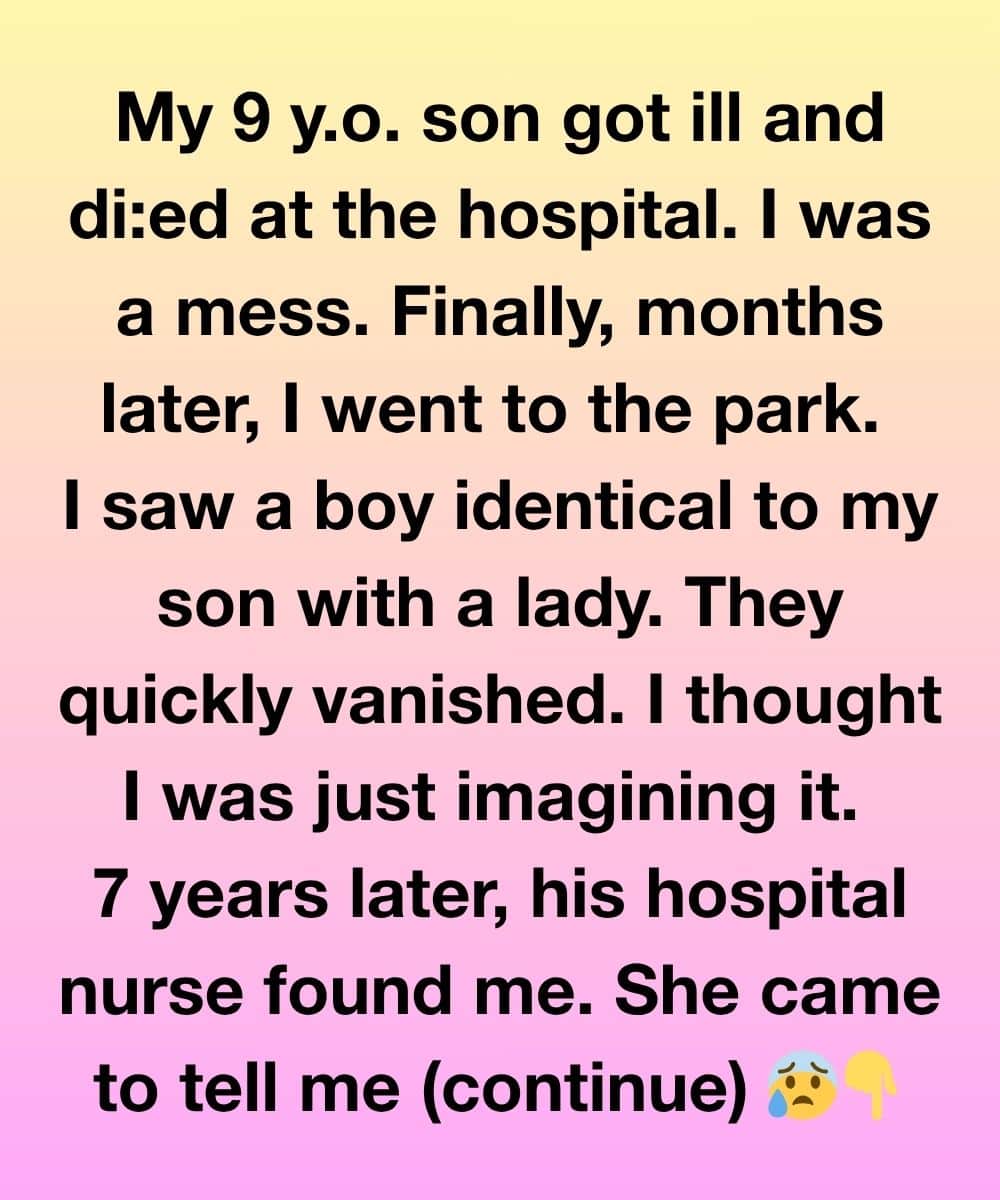
His name was Micah—crooked teeth, bony knees, a laugh like a squeaky screen door. My only child. My whole sky.
He got sick fast. One day he was barefoot in the backyard, scuffing a soccer ball through dusty grass. The next, he couldn’t keep water down. Bloodwork, scans, acronyms I’d never heard—something autoimmune, something nameless. His body turned traitor and nobody could tell me why.
We lived at the hospital for three weeks. I slept in a chair that bit into my shoulder blades, ate crackers from a vending machine, and prayed to a God I wasn’t sure I believed in. I sang to him. I held the thermometer, the puke basin, the IV line of my own heart.
One morning I woke up and he was gone.
They told me he “passed peacefully,” the way people do when they’re trying to fold a scream into a lullaby. I remember a tray clattering in the hallway and the sound ripping out of me anyway. I don’t remember the funeral. I barely remember that first year except for the hollow, the way grief turned time into fog.
Months later, my sister Mireya pressed keys into my hand and ordered me outside. I walked to our old park. Sun on my face felt like a stranger.
That’s when I saw him.
Same ears, sticking out just enough to be endearing. Same almost-on-his-toes gait, like gravity was optional. He was holding a woman’s hand, looking up, saying something that made his mouth twitch into the smile I’d bricked over in my memory. She clocked my stare, tightened her grip, and led him down a side path until the trees swallowed them.
I said nothing. Not to Mireya. Not to anyone. Grief does tricks. It rearranges your brain until you don’t trust your own eyes. I filed it under that.
Seven years slid by. I moved, learned the names of flowers at a part-time job, built a quiet life around a jagged absence.
And then, on a rainy Tuesday, someone knocked.
It was one of Micah’s night nurses—Lianne—with those cartoon sea-creature scrubs burned into my memory. Her face looked like news. She asked to come in, wrapped her hands around a cup she never drank from, and said, “I need to tell you something. It’s about Micah.”
Air got thin. I nodded.
She said she shouldn’t say it—that she’d signed papers—but she couldn’t keep it anymore. The night Micah “died,” someone came to the unit. A doctor from another department, calm as a winter lake, with transfer paperwork supposedly signed by me. A specialist. An experimental treatment. She knew Lianne’s name and credentials and spoke the language of hospitals so fluently no one questioned the dialect.
Lianne’s shift ended. By the time she returned, Micah’s chart read “deceased.” She assumed. She mourned. She never asked.
Until she saw a boy in a park in Mérida two weeks ago—older, but with the same ears and the same buoyant run. The vendor called him Mika. No “h.” The woman who watched him—Dr. Felina Gálvez—had once worked briefly at our hospital.
I Googled until my hands shook. Felina was brilliant and impossible in equal measure: fired years earlier for “ethical boundary violations.” There were old forum threads, scattered articles, whispers about radical ideas and rage at slow systems. A line kept surfacing: by the time the approvals came, children were already gone.
I found three phantom stories—parents with “no body recovered” in Brazil, in Greece, somewhere else on a map of heartbreak. Threads that brushed Felina’s name without tying a knot.
I bought a plane ticket.
Mérida is heat and color: bougainvillea spilling over walls, bells at odd hours, dogs that nap like landlords. I walked parks. I showed an old photo to the universe. On day four, a woman at a paleta cart licked mango from her thumb and said, “Mika. Fútbol by the old church. Sometimes with the doctora.”
My heart tripped.
I went every evening. Watched boys carve dust into comets. And then—there he was. Taller. Older. The same way he tucked hair behind an ear. The same slope of shoulder I had kissed a thousand times. I didn’t move. Fear and hope have the same weight.
A woman sat on a bench with a straw hat and a paperback. Felina. She looked older than the photos, softer around the edges, like someone who had traded sleep for vigilance.
I followed at a distance when they left—a yellow house with chipped paint, green metal gate, a potted herb leaning toward the street. I came back and waited with a sketchbook I pretended to fill.
On the third day, he came out with a bag of trash. I stood. “Mika?”
He turned. Those eyes. That smile—a flicker of recognition with nowhere to land.
“Can I talk to you?” I asked.
“I have to ask my tía,” he said.
Felina stepped out. Our eyes met and the air rearranged itself. She didn’t act surprised. Just… tired. She opened the gate.
Inside smelled like chamomile and garlic and laundry hung to dry. Mika—Micah—sat at the table. His knees jutted. He ate a tortilla chip like it was a delicate job.
He didn’t remember me. Not exactly. He said sometimes he had “early dreams”—a green blanket with ducks, a voice singing a song with no words. I used to wrap him in that blanket and hum until my throat ached.
Felina didn’t lie. She said she’d read his chart and seen a death sentence in a language she refused. She’d worked too long, buried too many, watched too much bureaucracy polish its excuses. She had an unapproved protocol she believed in with a fanatic’s clarity. She forged my signature. She called it “a necessary cruelty.”
For a moment, I hated her with the clean heat I’d saved for the universe. Then I looked at the boy across the table, alive enough to roll his eyes when I said I don’t like mango on pizza.
I stayed three hours. He told me about stars and NASA, about a teacher who made astronomy feel like possibility. He loved riddles, preferred blue paletas, and hated waking up early. He didn’t know he’d been taken. He thought “tía” had found him when his “mamá couldn’t be located,” a story tucked into his life like a stitch under a hem.
I asked if I could come back. He nodded.
Days turned into a rhythm—chess at the kitchen table, street food in the plaza, the world’s worst magic tricks, stories I had told a much smaller version of him that still made him laugh in the same places. Felina receded, giving us space with a grace I couldn’t reconcile with the theft. At night, I lay in a guesthouse bed and stared at a fan that clicked every third rotation and tried to hold both truths: the child who had been stolen; the child who had been saved.
Eventually, I asked Felina why. The real why. She said her brother died at ten. Same illness, different name. No one moved fast enough. She had built a life to outrun that feeling and failed. She swore she would never stand still again. “Micah was the only one,” she said quietly. “The only one I knew I could save.”
“It doesn’t excuse it,” I said.
“I know,” she answered. And I believed she did.
Two months in, I told Mika the truth. Slowly. Carefully. He didn’t shout. He didn’t accuse. He went quiet in a way that scared me more than anger. “I need time,” he said, and left.
Five days later, he knocked on my guesthouse door with a printed photo from my Facebook—the two of us on a beach years ago, both squinting into the light. He said, “I think I want to know you. If that’s okay.”
It was everything.
We learned each other in small doses. I met his friends. He met my sister on a glitchy video call that made them both laugh until they snorted. He visited the U.S. for spring break and discovered snow is mostly an idea you love from a distance.
We don’t press on the missing years too hard. They exist. They ache. They are also the reason he breathes.
Felina died last year. Cancer. She left him the house and a long letter. She left me a shorter one: “Forgive me, or don’t. I couldn’t watch another child disappear while people argued about forms. I hope the world grows kinder to boys like Micah. And to mothers like you.”
We cried in the kitchen with the chamomile and the garlic. We planted a jacaranda in my backyard—a little piece of Mérida that lit up in lavender in spring and made the air feel like it remembered something sweet.
Now Micah is packing for college. Biomedical science. He says he wants to make medicine faster and more human, to build bridges between need and help so nobody has to play outlaw to keep a child alive. He still walks a little on his toes. He still laughs like a hinge that needs oil.
Life didn’t stitch itself back together neatly. It rarely does. But sometimes, after the darkest midnight, there’s a second sunrise you didn’t dare ask for—and it finds you anyway.
If this found you at the right time, share it. Someone out there needs to believe in a second sunrise today.