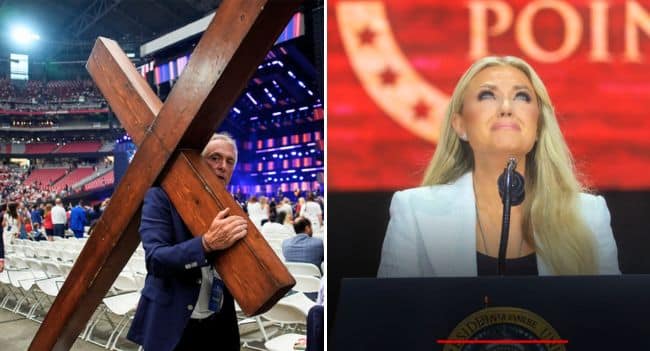
The line to enter stretched for more than a mile, yet not a single person turned away.
On September 21, 2025, State Farm Stadium in Glendale, Arizona, became more than just a sports venue—it became a monument. Tens of thousands arrived clad in red, white, and blue to honor Charlie Kirk, the 31-year-old founder of Turning Point USA, just ten days after he was fatally shot in Utah.
By mid-morning, the 73,000-seat stadium was filled to capacity, while the nearby Desert Diamond Arena packed in another 19,000. Still, families who had driven across the country parked miles away and stood in the 90-degree heat, saying it was worth it—even if they could only hear the faint echoes.
This was far more than a memorial. Homeland Security classified it as a SEAR Level 1 event, the same security ranking as the Super Bowl. Bulletproof glass surrounded the microphone, TSA-style checkpoints screened every attendee, and there were no bags, no exceptions. The heightened measures reflected not only the raw emotion surrounding Kirk’s assassination but also the prominence of those in attendance. President Donald Trump, Vice President JD Vance, Donald Trump Jr., Marco Rubio, Tulsi Gabbard, Robert F. Kennedy Jr., and Tucker Carlson all took the stage.
Trump called Kirk “a martyr now for America, freedom.” Stephen Miller’s words hit even harder: “You thought you could kill Charlie Kirk? You have made him immortal.” The crowd erupted like a lightning strike.
But the moment that stilled the arena came from Erika Kirk. Standing before 70,000 mourners, she spoke three words that froze the room: “I forgive him.” Forgiveness for the man accused of killing her husband—when anger would’ve been the easier choice. The crowd fell silent as she continued, “Charlie wanted to save young men, just like the one who took his life.” Then came her vow: “His passion was my passion, and now this mission is my mission.”
Erika Kirk now leads Turning Point USA as its new CEO, carrying on the movement her husband founded at just 18.
The event blended faith and tribute. Worship leaders Chris Tomlin, Brandon Lake, Kari Jobe, Cody Carnes, and Phil Wickham filled the air with hymns, while Lee Greenwood’s “God Bless the U.S.A.” brought the crowd to its feet in a roar reminiscent of 1984. Reverend Rob McCoy, Kirk’s longtime pastor, summed it up simply: “Charlie looked at politics as an on-ramp to Jesus.”
Supporters drove old Chevys painted with the Stars and Stripes across thousands of miles to be there. Others walked for miles after parking, drenched in Arizona heat, saying Kirk deserved no less. The scale stunned even organizers—initially expecting 100,000, by sunrise estimates neared 300,000. Within days of his death, Turning Point USA logged over 32,000 new chapter inquiries.
Trump closed the ceremony by announcing that Kirk would receive the Presidential Medal of Freedom posthumously—the highest civilian honor in the nation—awarded to a man who never held office yet built a grassroots empire. A few protesters gathered in designated areas, but their voices were drowned out by hymns, chants, and unity born from grief and conviction.
For most, it wasn’t just a farewell. It was a vow to carry on his mission. “He deserves us to be here,” one supporter said. Cameras captured the grandeur, the speeches, the music—but what lingered most was simpler: thousands of strangers, shoulder to shoulder in desert heat, refusing to leave even after the doors closed.
Charlie Kirk’s voice may be gone. His echo remains.