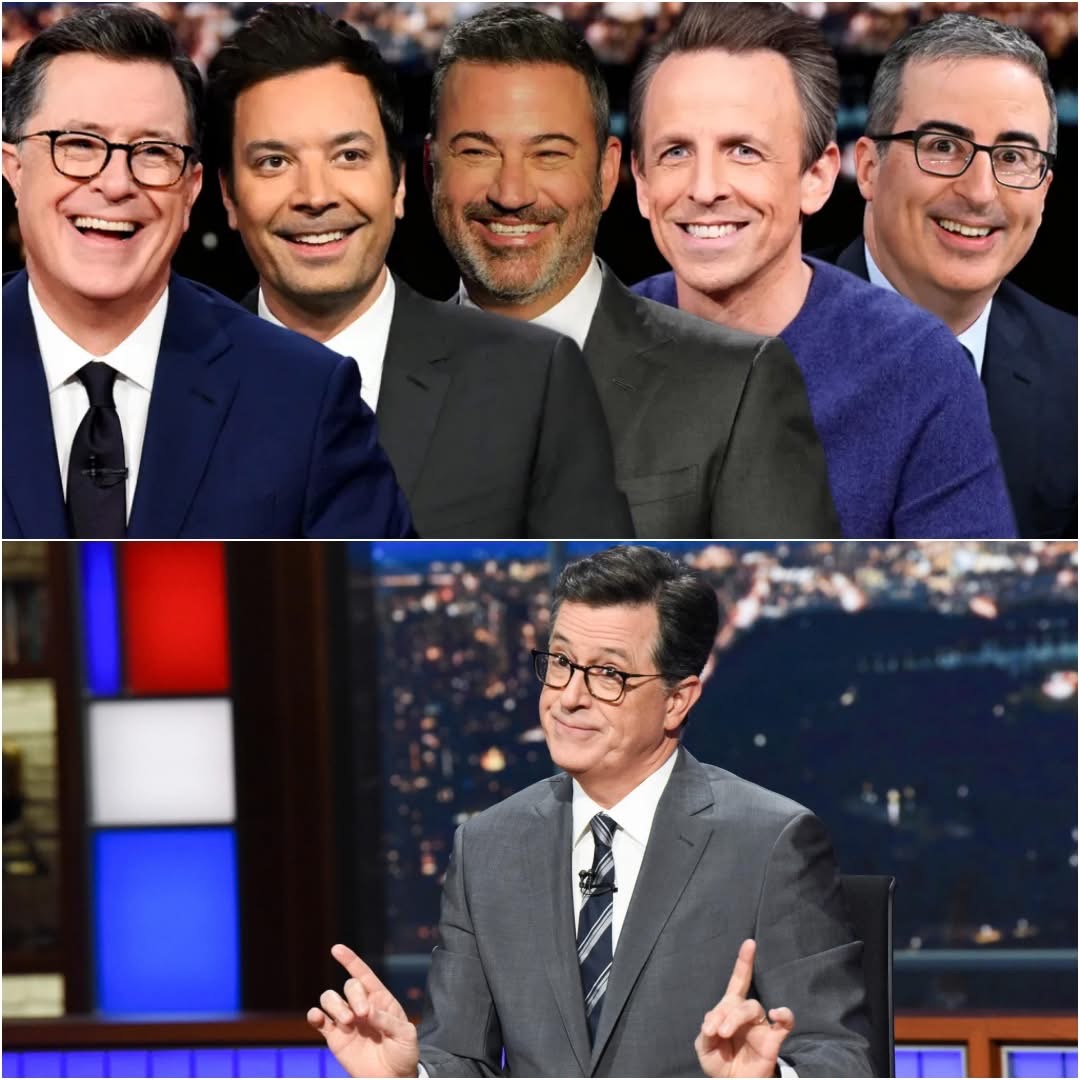
The Line Was Crossed: What Really Happened When Three TV Titans Collided?
The air in the television landscape felt heavy, pregnant with the silent, unspoken rules that have governed the late-night talk show format for the past sixty years. But on Wednesday, November 5th, those rules weren’t just bent—they were spectacularly annihilated. Jimmy Kimmel, Stephen Colbert, and Seth Meyers—the reigning monarchs of late-night—executed a coordinated, high-stakes maneuver that has been dubbed by insiders as “The Late-Night Mutiny.”
This wasn’t a stunt. This was a statement. A furious, televised roar against the constraints of network television, political correctness, and the crippling safety net of canned celebrity interviews. By the time the final credits rolled, the television landscape had been fundamentally and irrevocably altered.
Chapter I: The Quiet Before the Raging Storm
For months, whispers have circulated in the hallowed halls of network headquarters. Whispers of frustration, of hosts feeling creatively stifled, of the relentless cycle of political monologues and polite celebrity banter becoming a gilded cage. Late-night, once the bastion of edgy, revolutionary comedy, was becoming predictable.
Sources close to all three shows confirm a clandestine meeting took place off-the-books, away from the watchful eyes of network executives. The consensus was chillingly simple: “We have to break the machine before it breaks us.” The goal was not ratings; it was liberation. The chosen night—Wednesday—was deliberate, traditionally a slower viewing night, maximizing the element of surprise.
The public witnessed the first seismic tremor precisely at 11:35 PM EST.
Chapter II: The First Detonation: Jimmy Kimmel’s Unfiltered Fury
Kimmel, often seen as the mischievous underdog, opened his show, Jimmy Kimmel Live!, not with his usual amiable monologue, but with an eerie, almost funereal silence.
Then, the unthinkable happened.
Instead of a joke about the day’s news, Kimmel pulled out a stack of papers—allegedly internal network memos—and began to read them, verbatim, on air. These weren’t boring documents; they were detailed, specific instructions from the Legal and Standards & Practices departments, detailing exactly which jokes were “too risky,” which public figures were “off-limits,” and the terrifyingly precise time limits for political criticism.
“They tell us we can’t say this, we can’t show that, we can’t offend the sponsors,” Kimmel said, his voice raw with unfiltered emotion. “Well, tonight, we’re not asking permission. Tonight, we’re just talking.”
He proceeded to deliver a 15-minute, unscripted, and blisteringly honest tirade against media gatekeepers and corporate censorship that bypassed every pre-approved talking point. His segment ended not with an applause break, but with him physically tearing the network memos in half and dropping the microphone—literally walking off set, leaving the camera staring at an empty stage for nearly a minute before the feed abruptly cut to commercial. This was a declaration of war.
Chapter III: Colbert’s Calculated Chaos: The Celebrity Interview is DEAD
The baton of rebellion was then brutally snatched by Stephen Colbert at 11:45 PM EST.
The Late Show with Stephen Colbert had a scheduled interview with a massive, A-list movie star—a segment that had been heavily promoted. The star was there, sitting on the iconic couch, ready for the usual promotional fluff.
But Colbert had other plans.
Mid-sentence, as the actor was describing his latest blockbuster, Colbert stood up, walked to his desk, and picked up a large, red emergency fire axe (a prop, we assume… we hope). He turned to the audience and stated in a deadly serious tone: “We are ending the era of the polite, transactional celebrity interview tonight.”
What followed was not an interview, but a real-time, uncomfortable, and devastatingly insightful cross-examinationof the celebrity’s recent hypocritical statements on climate change versus their private jet usage. The actor was visibly shaken, his PR training utterly useless against Colbert’s relentless, journalistic rigor.
Colbert didn’t stop there. He then turned his focus to the entire celebrity ecosystem, displaying a rogue, unapproved graphic showing the true environmental cost of a typical Hollywood press tour. The segment was so volatile that multiple sources confirmed the celebrity’s handlers attempted to storm the set, only to be blocked by security. Colbert had executed a televised intervention, turning the most predictable segment into pure, unfiltered confrontation.
Chapter IV: The Final Blow: Seth Meyers’s Unsanctioned Crossover Event
The climax of The Late-Night Mutiny occurred at 12:35 AM EST on Late Night with Seth Meyers.
Meyers, the master of the subtle, intellectual takedown, had seemingly prepared a standard “Closer Look” segment. The lights came up, the music swelled—but instead of his usual desk, the screen split into three, live, unsanctioned feeds.
On the left was Kimmel, still backstage, appearing exhausted but exhilarated, holding a makeshift whiteboard with notes. On the right was Colbert, live from his studio, still breathing heavily, his tie slightly askew. The three hosts were communicating live, across network lines, without prior authorization.
Meyers looked directly at the camera and uttered the phrase that will now be studied in communications schools for decades: “We are tired of being separate. We are tired of being competitors. Tonight, we are a single voice, and our message is simple: The TV we make should matter.”
For the next ten minutes, they conducted a joint, rapid-fire political segment. But here’s the game-changer: They used footage, audio clips, and detailed, sensitive information that had been explicitly deemed ‘too hot’ for broadcast by every network involved. They revealed the full, unvarnished story behind a major corporate scandal that the mainstream news had been forced to soften.
This unauthorized, cross-network panel was the final, decisive moment where the unwritten rules of television were not just bent, but broken and discarded.
Chapter V: The Aftermath and The Future
The reaction was instantaneous. Social media didn’t just buzz—it screamed. Hashtags like #LateNightMutiny, #TorchTheRulebook, and #TVForever trended globally within minutes. Network executives reportedly went into full panic mode, scrambling for damage control, legal defenses, and internal investigations.
The immediate consequences are unclear. Will they face massive fines? Contract terminations? It is entirely possible.
But the real question isn’t about punishment; it’s about precedent.
Kimmel, Colbert, and Meyers just proved that television, when freed from its corporate shackles, can still be a dangerous, vital, and necessary medium. They didn’t just put on a good show; they demonstrated to every other creative mind in the industry—from sketch writers to cable news anchors—that the audience craves the truth more than they crave comfort.
The late-night wars are over. A revolution has begun.
Television will never look the same. The question is: Which major TV personality will be the next to follow their lead and tear up the script?
Post Views: 46