
The candles on the table leaned into their own reflections, soft halos trembling in the wineglasses. Salvatore’s warmed with the low thrum of familiar voices, cutlery chimes, and an old Sinatra recording that made even water taste sentimental. My parents—David and Marie—were flushed and happy in the amber light, hands touching, smiles lifting the room the way only four decades together can. I’d timed the slideshow to their favorite song. The custom menus were letterpressed. The cake—lemon and raspberry, our mother’s favorite—was waiting in the kitchen like a kept promise.
Then Vanessa stood.
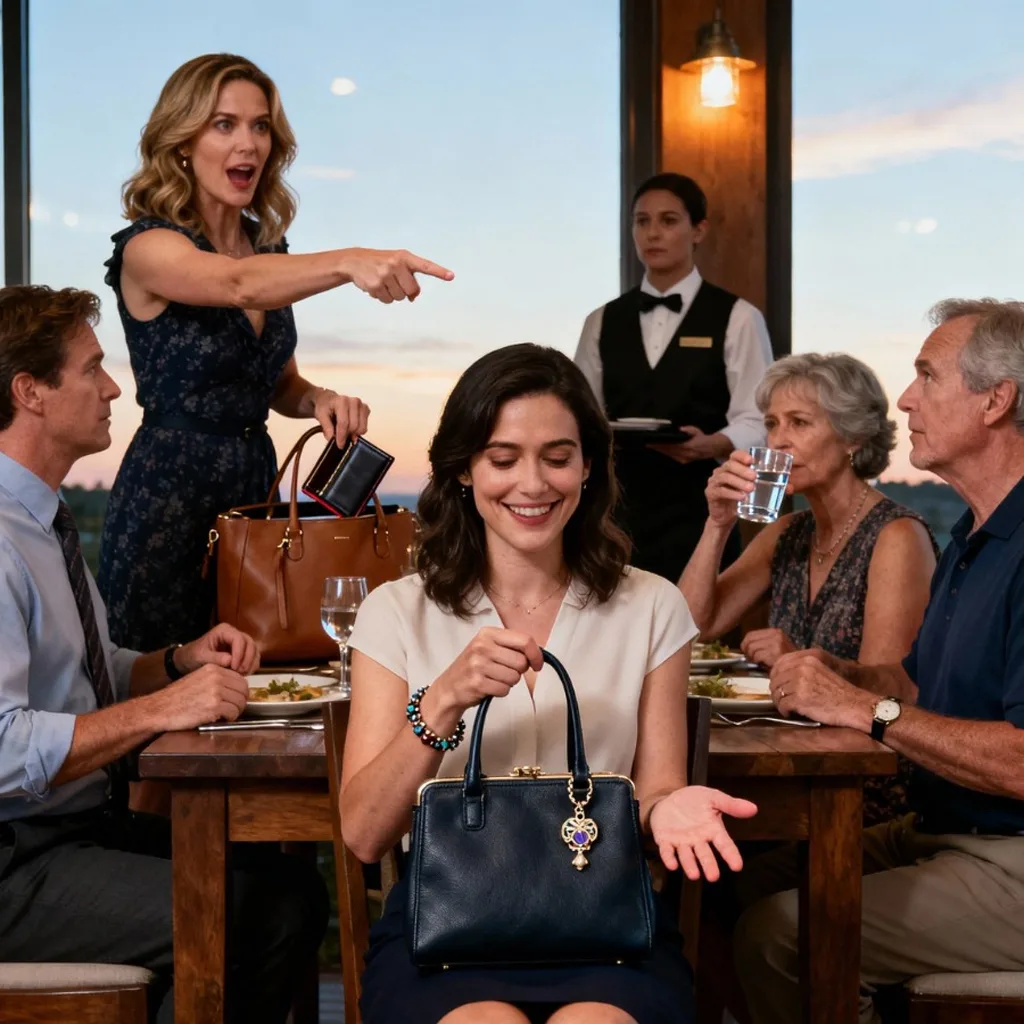
Her chair scraped too loud against the tile. She pointed at me with a manicured finger and said it like a line she’d rehearsed in the mirror. “You stole my wallet, you disgusting thief.”
The room paused, a whole restaurant holding its breath for the next line. My brother Eric’s face collapsed an inch; our mother’s eyes went glassy. I didn’t cry. I didn’t protest. I laughed—clear, sudden, unforced. Because the moment she rose, I knew the trap had finally sprung—not on me, but on her.
If you’ve never lived under the same roof as quiet warfare, it’s hard to explain how it dries you out, slowly. Vanessa arrived six years earlier with money that wore a perfume and a posture. Her father owned a constellation of luxury dealerships, and Vanessa introduced herself not with a handshake but with a curriculum vitae of superiority. She adored my brother with a devotion that felt theatrical. She tolerated the rest of us as if we were props.
I tried. Lunches that turned into critiques. Wedding planning that became a seminar in status. “Your apartment is so cozy, Gabriella,” she’d purr, eyes sweeping. “You design logos, right? That’s cute.” She spilled red wine on a dress I’d made by hand and called it an accident with a smile that didn’t reach her eyes. At baptisms and Thanksgivings, at birthdays and random Sundays, she made family into an audience and me into a foil. There are insults built for public spaces—hers was a fluent speaker.
My parents were diplomats by nature and career: Dad a high-school principal for thirty-five years, Mom a nurse whose calm could slow a heart rate. Their first instinct was always truce. Eric, who wanted love to be simple, translated Vanessa as “a different communication style.” He asked me to try harder to understand. I learned to step around her storms, to keep peace by going quiet. But silence is not peace; it’s just a soundproof room where resentment grows legs.
For the anniversary, I planned like belief. Salvatore’s, where my parents had their first date, said yes to every little request: the playlist, the menus, the family tree I illustrated late into the night. Vanessa counter-programmed. She changed the reservation time behind my back, suggested a different dress code, ordered a “more sophisticated” cake that ignored my mother’s taste. When I confronted her, she smiled with all her teeth. “Oh, I thought we were planning together,” she said sweetly. “Eric thought you might need help with an upscale event.” Eric didn’t say it. He also didn’t unsay it.
I moved the place cards like chess. Vanessa moved them back, placing herself next to our mother because “the eldest son’s wife belongs closest.” By appetizers, she was a satellite broadcast, every topic bending toward her. By entrées, I saw it—the oversized designer bag wedged between our chairs, not on the hook under her seat where the rest of us had our purses. When she returned from the restroom, she slipped something small and rectangular inside: a second wallet, not the red Prada she’d flashed earlier. The air around her felt charged with intention. I understood the shape of the evening.
Dessert arrived in a little procession. The restaurant dimmed, and the candles made everyone younger. Vanessa gasped. “My wallet,” she said, loud enough for neighboring tables to hear. “I can’t find my wallet.”
My mother’s hand went to her throat. “Are you sure you brought it?”
“I paid coat check,” Vanessa snapped, eyes skimming everywhere but her own bag. A beat of silence. Then she tilted her head at me. “Gabriella, you left earlier. Quite a while.”
“I spoke with Giovani about the cake,” I said, steady. “And I stepped outside for air.” My chest was quiet in a way I recognized from design deadlines, that tunnel where panic can’t fit.
Vanessa’s voice dropped into the register she uses for verdicts. “You stole my wallet, you filthy thief.” The room shrank to a border around our table. Eric stared at his hands. Dad’s jaw set. This is how falsehood hopes to win—by banking on your fear of spectacle.
Vanessa lunged for the tote between us. “If you’re innocent, you won’t mind if we check your things.”
“That’s not my bag,” I said, and watched her pull the red Prada out with a flourish, like a magician relieved to finally perform the trick. “See?” she crowed. “In the bag next to her. I told you.”
The gasp that went around the table had a familiar shape. Eric whispered, “Gabs… how could you?” The old doubt stood up inside me, the ghost of all the times I let her rewrite reality. And I laughed. Not making a joke of it—free of it. “I’m laughing,” I said, “because that’s your bag, Vanessa. You planted your wallet in your own bag. And if you reach inside again, you’ll find your initials on the compact, your brand of sanitizer, and your notebook of family grievances you pretend you keep for ‘gratitude.’ Also,” I added lightly, “Giovani installed cameras in the private rooms last year.”
Silence. Then Giovani himself, materializing from the edge like a stage manager who’s seen everything. “It’s true,” he said. “After an incident, we installed discrete cameras.”
Eric stood so quickly his chair bit the tile. “Show me.” Vanessa reached for his sleeve and missed. In the pause, I could hear my mother’s breath.
They were gone only minutes. Time did the thing it does when you’re waiting for a verdict—it became audible. Eric returned with a face like a winter window. “It shows everything,” he said to no one and to all of us. “You taking your wallet, putting it in the tote, arranging it by Gabriella, checking angles, and then… this.” Vanessa’s mouth opened and found no language. “Eric, please—” “Don’t,” he said softly, and it was the first time in years his voice had no wobble.
There was no applause. Just the small sounds of a room returning to itself—the ice settling in glasses, a knife laid carefully down. I stood and faced my parents. “I’m sorry,” I said, though I wasn’t apologizing for anything I’d done. “Not tonight,” Mom whispered, crying into my shoulder. “We should be sorry. We didn’t see.” Dad looked older and relieved, like someone who had carried something heavy by mistake.
On the patio, beneath the heat lamps, Eric stared at the city like it might offer instructions. “I feel like a fool,” he said. I told him the only thing that sounded true. “You wanted to believe the best about someone you loved. That’s not foolish.” He shook his head. “Stop being so understanding.” “I’m not,” I said. “I’m just done being small.”
Vanessa came out, anger and calculation warring on her face. Eric didn’t raise his voice. “Take Lucy home,” he said. “I’ll get a ride. We need space.” Power has a particular heat when it leaves the body. I watched it go. Inside, the cake arrived. We sang. It wasn’t the version of the night I’d planned, and it was still a good night, because it held something real.
After, time didn’t gallop. It moved like a person learning to walk again. Eric stayed with our parents for a while, telling Lucy that Grandpa needed help with a big project. Vanessa spun through denials, tears, apologies that sounded like arguments, and then threats. The footage kept its only promise: it told the same story every time. Within three months, the divorce papers had ink. Lawyers learned the schedules of school pick-ups. A co-parenting plan turned into a calendar on the fridge.
In the quiet that replaced the drama, our family rebuilt with the gentleness you give to a fragile thing you still want. Weekly dinners started clumsy and then found a shape. My younger sister Julia waited a whole evening to say, “I told you so,” and when she did, it made Eric laugh—the real kind that returns like an old song. Dad admitted what no principal wants to confess. “We kept peace so hard,” he said, “we didn’t see the war.” Mom squeezed his hand. She had always known when to bandage and when to let air in.
I took my own inventory. Therapy handed me new language: gaslighting, projection, intermittent reinforcement. Dr. Torres said, “You didn’t imagine it. You endured it.” Something in me unclenched. My work—design that had dimmed under the slow leak of vigilance—brightened. Clients said they could feel a difference, though they couldn’t name it. I hired help. I slept.
One afternoon, Sophia—Vanessa’s former college roommate—found me through a friend. Over coffee, she said, “She did it to me, too.” There’s a relief that feels like a key finally turning. We started a small group for people untangling from manipulative relationships. We learned to say, “It happened,” without adding, “but maybe I overreacted.” We learned to tell our stories without flinching.
A year later, at Lucy’s fifth birthday, the bounce house wheezed and the frosting stained everyone’s mouth blue. Vanessa stood across the yard, smile polished, edges intact, a person performing the role of a person. We nodded. It meant nothing and everything. Eric had begun to date a kind woman from Lucy’s school, the sort who brings extra napkins unasked. Julia thrived in surgery nights and still remembered to call Mom on her breaks. My parents, lighter now, danced in the kitchen because there was room.
People like stories where justice arrives on a drumbeat, humiliation repaid in kind, villains unmasked to unanimous boos. What happened to us was quieter. The trap snapped, yes, but the victory wasn’t the footage or the gasps or even the laugh that broke a spell. It was the slow return of proportion: truth where performance had lived, tenderness where strategy had fed.
I learned that patience isn’t passivity; it’s trust that time, given enough rope, shows you where the knots are. I learned that keeping the peace by disappearing is neither peace nor love; it’s complicity with your own erasure. I learned that laughter can be a release valve, a refusal to sign the confession a liar is writing for you.
Vanessa didn’t transform into a lesson; she remained a person with a pattern. Maybe she’ll change. Maybe she won’t. That’s not my story to edit. The gift wasn’t her downfall. It was the end of my rehearsal of smallness, the day my family stopped trying to tidy conflict into silence. On certain nights, when the city is soft and Sinatra feels earned, I remember the candlelight on glass, the scrape of a chair, the airless second before a choice. The room had waited for me to explain myself. I chose to laugh instead, and in that sound I heard the weird music of something fixing itself—not all at once, not loudly, but enough for the next breath to feel true.